Saturday, March 23, 2019

THE STORIES OF "US" (2019): BRUCE LEE MEETS "THE TWILIGHT ZONE" IN JORDAN PEELE'S TERROR TRIP THROUGH GENRE HISTORY - by CEJ


________________________________________________


US
Dir. and Written by - Jordan Peele 
Prod. by - Jason Blum, 
Ian Cooper, Sean McKittrick, Jordan Peele
Director of Photography - 
Mike Gioulakis
Edited by - 
Nicholas Monsour 
Production Design -
Ruth De Jong

Run Time: 116 mins.
Release: 
3/8/19 (SXSW) 
3/22/19 (US)
Universal Pictures 
Monkeypaw Prods.

GullCottage rating
(***** on a scale of 1-5)

___________________


     In the 1973 adventure classic ENTER THE DRAGON, as the sampan filled with the world’s greatest martial artists chugs towards the tournament on Han’s private island, self-inflated bad-ass Parsons (portrayed by Australian Shotokan black belt legend Peter Archer) flexes and shows off a few fight moves in front of Lee (Bruce Lee) in an attempt to goad Lee’s ego into “throwing down” right then and there on the deck of the craft in order to find out “straight-up and right now” who’s the more bad-assed. Then, in what remains ironically one of the most famous scenes in all of action movie history, Lee explains to Parsons “The Art of Fighting Without Fighting”.


     He convinces Parsons that fistifcuffing on the deck of the ship perhaps isn’t the best thing to do. So, he suggest they take a small lifeboat-like dingy to the shore of a nearby island. Parsons agrees and steps down into the dingy, then Lee untethers the craft from the ship, watches Parsons float away into the distance, then goes about his earlier business. Hence “The Art of Fighting Without Fighting” is when one puts his or her ego in check long enough to realize that it isn't  always the most obvious first reaction action which is the most effective. The last time we used that analogy for a film was when describing Robert Zemeckis’ brilliant 2000 mystery-cum-ghost story WHAT LIES BENEATH to a friend as “The Art of Doing Hitchcock Without Doing Hitchcock”.


     In that film by putting the “I know my Hitchcock as much as anyone else, and I’ll prove it” part of his ego in check, and by not doing the “Brian DePalma thing” of specifically patterning shots after frames from earlier Hitch thrillers, but rather taking the soul of Hitchcock and “implanting” it within an entirely new 21st century filmic body, Zemeckis’ WHAT LIES BENEATH ironically became the most faithful Hitchcock homage in years. Now, whew!, all of that to explain how in similar fashion Jordan Peele, after the stunning success of his 2017 horror / satire GET OUT, had a lot to prove on his sophomore outing. But instead of succumbing to the ever-so-tempting “Look, Ma, I’m directing!” instinct, with the gleefully creepy US he puts his ego on hold, crafts a multi-layered chiller diller, and gives us one of the best “evil doppelgänger” yarns ever in the history of a genre visited before by the likes of Harlan Ellison, Rod Serling and other such titans of weird fiction.

     Sorry for the few run-on sentences there. But at the same time not so sorry as this one's got us stoked because quite simply you can’t be a hack and keep company with folks like Ellison and Serling. And while not trying to compete with or imitate any such literary or filmic icon, Peele ironically - not unlike Lee and Zemeckis - more than holds his own with them, and at times (forgive the sacrilege) might even excel past them with a clever piece of cinema grimoire both familiar and startlingly unique for the era in which, and for which, it was created.


     US doesn’t seek to invent a new genre. Nor does it seek to ape one down to the letter either. Rather it sets out to re-introduce a classic (if more obscure) sub-genre to a younger audience in modern fashion - thus turning said younger audience into fans of the original material, … which it’s kinda like and not like at the same time. You follow? Yeah, we know it's a little weird sounding. But it makes sense. In fact in that regard US the film is in some respects a lot like the doppelgängers who show up to torment their physically (and quite possibly psychologically) twin family.

      This is a no spoilers review, so we won’t allude to anything you haven’t already surmised from the trailers, clips, TV spots or cast interviews on various talk shows. US opens in 1986 where, after wandering away from her family during a beach trip to Santa Cruz, 10 yr. old Adelaide Thomas finds her way into a carnival’s hall of mirrors, and is traumatized by meeting a horrific exact living double of herself. Unable to verbalize the terror, she, not unlike an assault victim, silently carries the trauma into adulthood - where her present day self is portrayed by 12 YEARS A SLAVE and BLACK PANTHER‘s Lupita Nyong‘o.


     Adelaide has managed to keep her psychological / emotional demons at bay and away from her family for her entire adult life. That is until during a new trip to the same beachside community the unspeakable springs to life four times more terrifying than before as not only her evil double returns as an adult, but so do those of her husband Gabe (Winston Duke), daughter Zora (Shahadi Wright Joseph) and son Jason (Evan Alex) - all of them for some unknown reason violently intent on taking the places of the real family. And from this point the TWILIGHT ZONE-ish version of the $54,000 DOLLAR QUESTION becomes  “Are the evil doppelgängers of supernatural origin, strange clone-like physical origin, are they from another parallel dimension, or (like something out of a Shirley Jackson novel) a product of one or more of the family members’ inner psyches projecting themselves into our reality in corporeal form?”.


     US interestingly answers that question for the audience halfway through the film then makes an intriguing - if not entirely successful - course change into becoming another kind of film during it’s second half which raises an entirely new set of questions for the audience to brain tease it's way through. As for that second half we say “If not entirely successful” because (for our money anyway) in such a horror thriller very often less is much more as the questions and freakish answers which each individual audience member comes up with in the cinema of their own minds is usually infinitely more fascinating and terrifying than anything a filmmaker can explain or physically show. This isn’t always a bad thing. Think of Steven Spielberg’s JAWS - where the first half is a straight up horror film, and the second half becomes an adventure story, and both work like gangbusters.

DUEL (1971)

     But also consider Steven Spielberg’s earlier 1971 tv movie DUEL - released outside the U.S. as a feature film where in some versions you actually see a driver’s hands, feet, etc. in the cab of the marauding 18 wheeler hell-bent on turning motorist Dennis Weaver into canned road kill. This as opposed to the original tv version where we never saw inside the cab, and never knew if there was a madman behind the wheel or if the vehicle was powered by some supernatural Theodore Sturgeon or Stephen King-like entity possessing it and turning it into a killing machine on wheels. By the way, Spielberg has gone on the record stating that he himself prefers the version of DUEL where you don't see inside the cab.

     Peele’s explanation for what's going on (well, kind of a partial explanation, anyway) is freakishly intriguing to be sure, but it’s nowhere near as fever dream scary as when we have no idea - or even a guess - whatsoever, and we as an audience are hopelessly trapped in what Rod Serling’s opening TWILIGHT ZONE narration famously described as that land of the imagination “between light and shadow”, “between science and superstition” and “between the pit of man’s fears and the summit of his knowledge”. That’s a damned scary place, but an intellectually fascinating one at the same time. And writer / director Peele seldom misses a beat in wringing every single drop of sweat from our pores, and keeping every single electro pop of brain energy a’burnin’ in our noggins as we try to figure out this wild cinematic world he’s plopped us smack dab down into the middle of. It's helluva fun ride.


     The TWILIGHT ZONE analogy is entirely apropos as, not only will Peele’s new re-imagining of Serling’s venerable series begin its run on CBS’ All Access steaming service in a few weeks. But because Peele has also acknowledged how the original 1960 TZ episode “Mirror Image” (written by Serling, directed by John Brahm, and starring Vera Miles - the one where she encounters an exact double of herself in a bus station) was the primary inspiration for his film just as another TZ episode, Richard Matheson’s “Little Girl Lost”, was the creative first spark which brought Spielberg and Tobe Hooper’s POLTERGEIST into existence.

     The great thing about US and POLTERGEIST, however - in keeping with the Bruce Lee “Fighting Without Fighting” edict, is that they don’t redo the original stories and try to pretend they’re new - y’know, in the way that INTO THE STORM pretended it wasn’t a carbon copy of TWISTER, SELF-LESS acted like it wasn’t John Frankenheimer’s SECONDS with a new coat of paint, or INTO THE BLUE (Xeroxing THE DEEP), PROUD MARY (a connect-the-dots retread of Cassavetes’ GLORIA) and numerous other films of late have been “trying to smoke it passed audiences“. Uh, uh! Hell, US refreshingly isn’t even beholden to the (admittedly entertaining) Quentin Tarantino / Brian DePalma “food processor” brand of cinema either.

     Y'know, that thing where a number of scenes are reproduced from classic films (sometimes even down to costumes, camera angles and music) yet strung together into an entirely new film. Along those lines take a look and take note of DePalma’s “Odessa Steps” sequence as realized in THE UNTOUCHABLES, Uma Thurman’s yellow Bruce Lee GAME OF DEATH jumpsuit in KILL BILL, as well as the angle and editing of KILL BILL’s hospital sequence (lifted from Frankenheimer’s BLACK SUNDAY), the design of it’s “House Of Blue Leaves” battle climax setting (lifted from Sydney Pollack’s THE YAKUZA), and the very “slave to bounty hunter to vengeful hero” plot of 2012’s DJANGO UNCHAINED - a stringing together of the plots of the three 70s era Fred Williamson revisionist westerns THE LEGEND OF NIGGER CHARLEY (‘72), THE SOUL OF NIGGER CHARLEY (‘73) and BOSS NIGGER (‘75). For as much as we love DJANGO UNCHAINED, the fact is it's very much a combined "Reader's Digest" version of those three films with a hip 21st century attitude.


     Make no mistake, US is definitely a genre fanboy’s thematic Cuisinart version of a wet dream.  But it’s not a retread. And that’s a super-important and very noticeable difference. More like in the same way in which Peele’s earlier GET OUT was a modern day DNA transplant of THE STEPFORD WIVES, so is US the latest entry in the sci-fi / horror sub-genre of the age old evil doppelgänger yarn. And if it’s true that the most reworked story in cinema history is Dickens’ OLIVER TWIST - redressed and revisited as EMPIRE OF THE SUN, THE COLOR PURPLE, CLOCKERS, AN AMERICAN TAIL and more over the last century of film, then surely the doppelgänger tale, perhaps second only to the "paradox of time" story, is among the most revisited in the sci fi / horror realm.

Fetching the Fetch: "How They Met Themselves" by Dante Gabriel Rossetti -
watercolor version, c. 1860-64

     In addition to TZ’s “Mirror Image” some of the most popular and surely memorable incarnations of the doppelgänger sub-genre include the original STAR TREK series’ “Mirror, Mirror” (the one with the evil Kirk and Spock with the goatee - remember that one?), one of the best of Irwin Allen’s original LOST IN SPACE episodes - 1967’s “The Anti-Matter Man” (where a rift in the timespace continuum causes an evil Robinson family and robot to slide through and battle the good ones), and one of the most gripping episodes of 80s era television period - genre or not: the 1985 debut episode of the revamped TWILIGHT ZONE series, “Shatterday”, based on a story by Harlan Ellison, starring Bruce Willis, and directed by Wes Craven.

(Top to bottom) HOW THEY MET THEMSELVES
THE TWILIGHT ZONE - "Mirror Image" (orig. airdate 2/26/60),
LOST IN SPACE - "The Anti-Matter Man" (orig. airdate 12/27/67),
STAR TREK - "Mirror, Mirror" (orig. airdate 10/6/67)

     All of those stories - each damned clever and witty in their own right - aren’t rips of one another, but rather like the OLIVER TWIST reworkings are all to greater or lesser degree based upon the original Irish folk legends of the Fetch more than anything else. So, yes, Peele’s film does doff its cap to what came before. And, hell yes!, in parts it feels like a deliberate “Cinematic Easter Egg Hunt to End All Easter Egg Hunts”. For example in the very first scene / opening shot we notice four VHS video tapes strategically placed alongside an 80s era television set - three store bought tapes and one home recorded one. And if you’re familiar with the plots of the movies on the three store bought tapes it’ll give you a little heads-up as to some of US’s upcoming narrative elements.


     If you’re also familiar with other 70s era films (those of Peele’s formative inspirational years) like the NIGHT STALKER tv movie sequel THE NIGHT STRANGLER, THE REINCARNATION OF PETER PROUD, DON’T LOOK NOW and Philip Kaufman’s remake of INVASION OF THE BODY SNATCHERS, then there are additional specific scenes in Peele's film which will surely make you grin with a sense of “insider joke” familiarity every bit as much as they made us grin like big goofballs. So, yeah, Peele’s film is a horror film with something in it for everyone, especially the genre fan. But once again it acknowledges a love of these films - functions as a living stroll down horror memory lane (if you will) - without blatantly ripping off what it sees on the side of the road and trying to pass it off as it’s own. It acknowledges what came before but says, “Let’s take the DNA of that and not create a clone, but an entirely new being with it’s own voice and personality (it’s own soul if you will), but which very much remembers where it‘s DNA came from”. And, oh yeah, on the “horror” subject …

Rolling Stone - February, 2019

     No "if"s, "and"s or "but"s, US is a bonafied horror film. In a January 2019 interview with Rolling Stone’s Peter Hiatt, writer / director Peele flat out acknowledged that after the “Is it a horror film or a thriller?” (as if one film can’t be both) “genre confusion” of GET OUT, what he wanted to do next was a no-holds-barred, flat out “’spill your soda’ scary” (his words, not our’s) horror tale. And that’s what we get.

     US isn’t a perfect film. As mentioned earlier we found the first half more terrifyingly gripping than the second half (which is suspenseful). And even during that first half many of the scenes for our money run on a few extra beats too long. It’s as if Peele is so in love with the cleverness of his material in each scene he can’t bear to cut or lose any of it even for the sake of dramatic pacing. And as such there are a few lags in that first half because of it. At its best US plays like the crème of those lean and mean “one stab” / single-premise-with-multiple-permutations-and-possible-outcomes 70s era tv movies like THE NIGHT STALKER, BAD RONALD, DUEL, SATAN’S SCHOOL FOR GIRLS, THE NORLISS TAPES and THE HORROR AT 37,000 FEET. And when you think about it part of what made those films so to-this-day memorable (and still scary) was their brevity.


     US is great running at just under two hours. And it would have been even better had it come in closer to 95 or 100 minutes. Even those other 70s theatrical films like PETER PROUD and DON’T LOOK NOW - in which US is in obvious and understandable head-over-heels love - clock in at a shorter running time than Peele‘s. And part of their success is in how they don’t allow their premises to overstay their welcome. They dramatically know how to (as we used to say back in the day) “hit it then git it”. And US comes precariously close to forgetting that.  As for the execution of it's other craftsman-like details, Peele's rollercoaster is a cinema textbook masterpiece.

     The score by classical and contemporary composer & teacher Michael Abels is a freakish work of mad genius. It’s amalgam of chanting OMEN-like chorus, Afro-Cuban percussion and orchestra manages to simmer on the back burner of the audiences' memory long after exiting the theater. And the film's visual execution, concocted by Peele and cinematographer Mike Gioulakis (IT FOLLOWS, SPLIT, GLASS), is eerily unnerving and endearingly playful at the same time.


     The opening sequences in 1986 are filmed in almost CHARLIE BROWN / E.T.  childhood-point-of-view fashion with the camera seldom rising above the height level of young Adelaide, and the adults mostly seen from the waist down until leaning over into the frame to converse with our young protagonist. It's both cute and creepy at the same time. Then later there’s (quite cleverly) hardly a scene where the members of the cast are filmed in the center of the frame in classic fashion. The most prominent “center of the frame” traditional visual moment is during the scene we see in the various trailers and tv spots - when the “alternate family” first appears at the end of the driveway dressed in red coveralls and holding hands.

(L to R) Composer Michael Abels and
Dir. of Photography Mike Gioulakis
     Once the “alternate family” suddenly splits off in all directions like a macabre flock of birds breaking formation, all hell breaks loose both narratively and visually with characters both good and bad moving off to the left, right or bottom of the frame and throwing the visual balance slightly off this way and that. It’s barely noticeable consciously. But not unlike how in the old BATMAN tv series, whenever we were in the villains’ lair and the camera was always tilted, it here sends off a subconscious sonar “ping” to the audience that something’s not quite right.

     In light of all of this, and especially after the film’s final reveal, we admit the stuff about the running time and scenes in the first half being a bit too long emerge as minor quibbles in what is hands down one of the best modern day horror films to come along in years.

     As popular and well made as are the more recent slate of cinematic terror trips (films like INSIDIOUS, THE CONJURING, THE EXORCISM OF EMILY ROSE, ANNABELLE, THE UNBORN, THE NUN, etc.), we’ve just never been as taken by them the way many others are because to us too many of them rely upon CGI trickery to create their nightmarish imagery. For us, in the same way in which watching actual stunt personnel doing actual feats of derring do as opposed to their obvious CGI counterparts doing the same, so do we believe that the film audience not only sees but feels the difference deep in their gut when freakish fever dream imagery is realized mostly in camera. There's a sense of unexplainable creepiness and dread in subconsciously knowing that actual physical reality is somehow being twisted right before our eyes. And this is part of the reason why films such as THE EXORCIST, the original THE OMEN and THE AMITYVILLE HORROR, and even many of Universal's horror hits of the early 1900s like DRACULA and FRANKENSTEIN still somehow remain timeless today. It's not just nostalgia. They've somehow managed to bottle psychological lightning and preserve it via the physical cinematic arts. Peele's film does the same. 


     It's easy to forget how small scale some of the creepier TWILIGHT ZONE, OUTER LIMITS and NIGHT GALLERY episodes were. Most of them took place on maybe three sets at most, featured but a handful of actors (usually no more than four or five main speaking roles), and were shot with only one or two cameras usually locked into place, or at best on short-tracked dollies. But the ideas were so big the eye forgot to notice the lack of extravagances and uber technical razzle dazzle. The story, characters and director’s sense of style are what were king. And there was a Bruce Lee-like confidence in that alone for the film and filmmaker to feel secure in not having to ape or imitate what came before, or to slam the audience up against the wall in the cinematic / sensory equivalent of a gang rape in order to provoke an emotional response.

At the US South by Southwest Festival premiere: (L to R) Writer / Director Jordan Peele and cast -
Lupita Nyong'o, Winston Duke, Shahadi Wright Joseph, Evan Alex, Tim Heidecker, Elisabeth Moss

     While among the best of modern day horror, Jordan Peele’s US is at the same time a throwback to the days when “the idea” ruled. And in our present era where every other week rolls out yet another zombie or vampire tv series or flick - such to the point that many start to look and feel the same - it’s refreshing to see a genuinely creative and lovingly nostalgic spin on an age-old genre without resorting to simply ripping off what came before and claiming it as "the new cinematic thang". While faced with an impressive and daunting history of similarly themed films and series created by some of the legends of the genre, with US Jordan Peele has staked his own worthy claim as artist provocateur par excellence in “the Art of Terrifying An Audience With An Evil Doppelgänger Tale … Without Doing The Stereotypical Evil Doppelgänger tale”.

     We think Bruce Lee would approve.  ;)


                                                                                                                CEJ

________________________________________________

Vaulted Treasures is part of The GullCottage / Sandlot - a film blog, 
cinema magazine, growing reference library and online network 
"Celebrating The Art of Cinema, ... And Cinema As Art"

Explore The GullCottage / Sandlot @

Saturday, December 1, 2018

PETER YATES' "ROBBERY" ('67) - WHAT "HEAT" & "MISSION:IMPOSSIBLE" WANNA BE WHEN THEY GROW UP - by CEJ


________________________________________________

VAULTED TREASURES: MOVIES YOU NEVER KNEW ABOUT, YOU FORGOT, 
... OR YOU FORGOT TO LOVE MORE THE FIRST TIME AROUND!


Dir.  by - Peter Yates
Written by - Peter Yates, Edward Boyd, George Markstein, Gerald Wilson
From  - "The Robber's Tale" 
by Peta Fordham
Prod. by - Stanley Baker, 
Michael Deeley
Music by - Johnny Keating
Director of Photography - 
Douglas Slocombe
Edited by - Reginald Beck 
Art Direction - 
Micheal Seymour

Running Time: 110 mins.
Release: 9/21/67 (UK) 
9/27/67 (US)
Embassy Pictures (UK)
Paramount Pictures (US)

GullCottage rating
(***** on a scale of 1-5)
___________________


     Streaming is wonderful, but many cinematic gems (for various reasons) have yet to make the leap to NetFlix, Hulu, Blu-ray or even DVD. In fact some have never been released in ANY home video format. And for this reason we saved our old school VHS tapes / players and DVD burner; and love to return "to the vaults" to relive old faves.

     Today it's commonplace (and common sense) for actors to start their own production companies in order to find good material from which they themselves can at times snatch a decent character role, and at other times maybe not appear in but from which they can take a measure of creative satisfaction by shepherding to the screen a "pet project" they just have to get before an audience. James Garner's Cherokee Productions gave birth to TV's iconic THE ROCKFORD FILES and films such as GRAND PRIX and SUPPORT YOUR LOCAL SHERIFF. Clint Eastwood's Malpaso gave the world DIRTY HARRY, ESCAPE FROM ALCATRAZ and more. Sean Connery founded Fountainbridge, Will Smith - Overbrook, Tom Cruise - CW and so on.

Directed by Peter Yates, ROBBERY is a speculative take
on the infamous "British Royal Mail Train Robbery" of Aug. 3rd, 1963

     But to date one of the most impressive was also one of the earliest - formed by Welsh actor / producer Stanley Baker in the 1960s. One of British film history's most recognizable faces (we promise you've seen him time and again - he having starred in over 70 films including THE GUNS OF NAVARONE, ZULU, HELL DRIVERS, SODOM AND GOMORRAH and more), one of his most iconic films as actor and producer also happens to be one of the greatest crime thrillers ever made. Surprisingly still all but unknown in the U.S. (and we hope to help remedy that situation), it's cinematic DNA - along with it's director's signature style - directly lead to the creation of the classic American Steve McQueen police thriller BULLITT, the intricate 1972 heist comedy THE HOT ROCK with Robert Redford and George Segal, and (while we've never heard or read anything "official" along these lines) we've always found it all but obvious that it was a primary influence on Michael Mann's highly regarded 1989 TV movie L.A. TAKEDOWN and it's even more highly regarded 1995 kinda sorta remake / expansion film HEAT. Yeah, that's a helluva filmic pedigree. And it belongs to Peter Yates' 1967 burnished gem of a caper yarn ROBBERY.

Stanley Baker (far right) leads the crew both as "Clifton" -
the team's criminal mastermind - and as one of the film's primary producers.

     Britain's legendary "Great Train Robbery" (not to be confused with the events of the Michael Crichton Victorian era novel / film) took place in the early morning hours of Aug. 3rd, 1963 on the Bridego Railway Bridge near Mentmore in Buckinghamshire. It was there that a gang of 15 men (none of them carrying firearms) pulled off the complex and momentous task of tampering with the line's railway signals, thus secluding a Royal Mail train heading from Glasgow to London, and robbing it of £2.6 million (£48 million in today's currency / $75.5 million in today's U.S. dollars). While most of the gang was eventually found and arrested, the bulk of the stolen money was never recovered.

(pub. 1965)

     Over the next 50+ years almost 20 books would be published on the Great Train Robbery, each offering varying accounts and theories as to who was the true mastermind behind the heist, and whether or not he (or she) was ever captured. The first two - published shortly after the actual incident, and while investigations, searches and trials were still being conducted, were 1964's "The Great Train Robbery" written by Scotland Yard investigator John Gosling - it telling the story from the police perspective; and 1965's "The Robber's Tale". Penned by Peta Fordham, the wife of one of the barristers representing gang member Ronnie Biggs (who was convicted but escaped prison after having served 15 months), "Robber's Tale" proudly brandished the subtitle "The Real Story Behind The Great Train Robbery". But most felt it was a hastily written and exploitative documentation containing numerous unverified innuendos, and which contained no more "inside" information about the robbery and subsequent trial than was already available to the general public via reams of press coverage.

     The future producer of classic American films such as THE DEER HUNTER and BLADE RUNNER, in the 1960s Michael Deeley was best known in his native England as the man behind numerous British TV series as well as 1965's award winning comedy film adaptation of the popular stage play THE KNACK ... AND HOW TO GET IT. After securing the rights to Fordham's book he brought it to director Peter Yates, who at the time only had two previous feature film credits to his name and had primarily been known as a TV director on series such as THE SAINT.

Dir. Peter Yates (circa early 1960s)

     After their project was turned down by Woodfall Productions (the company co-founded by James Bond producer Harry Saltzman), Deeley and Yates brought it to actor Stanley Baker, who as star and producer of the hit film ZULU (1964) had established a good working relationship with that film's financial backer - legendary British film mogul Joseph E. Levine. Levine agreed to bankroll ROBBERY and the project was a go.

     As those "varying accounts and theories" surrounding the events of the robbery were still being debated as Deely, Yates and Baker embarked on the creation of their film (hell, the James Bond film THUNDERBALL would even jokingly imply that super-villain Ernst Stavro Blofeld's organization SPECTRE was actually the brains behind it), they decided to make no pretense at attempting to adhere to "hard and fast documentation"; this in the event that years (or even months) later newly discovered evidence or testimony would discredit and / or seriously date their feature. As such ROBBERY's screenplay (co-written by Yates, Edward Boyd and George Markstein) would make the gang members a fictitious amalgam of the actual crew. And all of the events leading up to the 25 minute robbery itself - in the film painstakingly, realistically (and oh soooo stylishly) recreated from the court testimonies of the perpetrators - would be speculative fiction.

Producer Michael Deeley (top left) on THE ITALIAN JOB (1969)

     To give the film more appeal in the U.S. an American character was written into the original script as the actual mastermind behind the heist. Legendary gangster actor George Raft originally signed on, but had to back out when England's Home Office refused him entry to the country because of his real life mob associations. Three days of footage was actually later shot aboard Joseph E. Levine's yacht on Long Island (U.S.A) with American actor Jason Robards (ONCE UPON THE TIME IN THE WEST, ALL THE PRESIDENT'S MEN) as the "brains behind the caper". But it was later decided not to use the scenes and keep the operation an all British affair.

     As such the final cast included Stanley Baker as gang leader / mastermind Paul Clifton, James Booth (ZULU) as Inspector Langdon, Joanna Pettet (who'd co-starred in the 1967 James Bond spoof vers. of CASINO ROYALE) as Clifton's wife, Kate; and as various gang members - Frank Finlay (THE LONGEST DAY, THE THREE MUSKETEERS), Barry Foster (BATTLE OF BRITAIN, FRENZY), Clinton Grey, George Sewell and other recognizable character actor favorites from the UK's stage and screen world.


     Whether thrillers, comedies or searing dramas, the films of one of our all time favorite film makers, the late director Peter Yates (1929 - 2011), were known for their gritty representation of character as well as swift pace. THE HOT ROCK, FOR PETE'S SAKE, THE FRIENDS OF EDDIE COYLE, THE DEEP, the hybrid action-comedy-drama MOTHER, JUGS & SPEED, along with BREAKING AWAY, KRULL, THE DRESSER, ELENI, SUSPECT and THE HOUSE ON CARROLL STREET all garnered Yates worldwide critical acclaim. But, as is often the case with most departed film makers, that world would remember Yates for one work in particular - in this case his 1968 American directorial debut BULLITT.

BULLITT (1968)

     In a Jan. 11th, 2011 New York Times obituary written about Yates, Bruce Weber stated, "Mr. Yates’s reputation probably rests most securely on BULLITT – and indeed, on one particular scene, an extended car chase that instantly became a classic". But what most (in our opinion heart-achingly) fail(ed) to recognize and cite among Yates' list of genuinely impressive cinematic accomplishments is that BULLITT was deliberately patterned after the super-cool look (in costumes and sharp cinematographic angles), tone & feel (in terse, near pulp-like dialog and jazz-influenced score), and even in it's hair raising car chase sequence very much after ROBBERY.

(Clockwise from top) Dir. Yates with Steve McQueen on BULLITT ('68),
with Barbra Streisand on FOR PETE'S SAKE ('74), with Alex Rocco on
THE FRIENDS OF EDDIE COYLE ('73), and with Nick Nolte, Jacqueline Bisset & Robert Shaw on THE DEEP ('77)

     The first 15 minutes of ROBBERY - a considerable chunk of screen time for a film running 110 mins. - opens with a bang. A mini-movie in and of itself, and every bit as hair-raisingly exciting as a 007 movie pre-credit sequence, we the audience are thrown headlong into the third act of the latest in a string of capers designed to raise capital for the gang's "ultimate crime" - the titular later-to-come Royal Mail train heist. Using anesthetic gas Clifton's second-in-command, Frank (portrayed by Barry Foster), and a handful of others knock out a diamond courier, then, after hustling him into the back of an ambulance to cut the jewel-laden briefcase from his wrist, are spotted by police. A chase then ensues through London's crowded streets.


     Resorting to their "Plan B" escape alternative, at every couple of street corners - as their getaway car screeches around the bend, another gang member leaps near-Kamikaze-like from the vehicle, and violently rolls to a stop off-road or under a parked truck to then elude the police on foot. Perhaps surpassing the later chases of BULLITT, THE FRENCH CONNECTION and THE SEVEN UPS (those three films produced by American filmmaker Philip D'Antoni), in retrospect - especially if you watch the films after viewing ROBBERY - it is painfully cinematically obvious that all of those now-classic aforementioned tire-and-asphalt-burners were to greater or lesser degree patterned after the opening minutes of ROBBERY - it's chase still one of the most mind-bogglingly shot (as in the audience wondering "Jeez! Was anyone killed while filming this?") in action movie history.


     By the way, no! No one was killed during the realization of ROBBERY's hair-raising introduction. But, as with Yates very next film, BULLITT, the cinematic pace and intensity is ratcheted up exponentially by grade "A" contributions from a sterling technical crew - in this case including the down-and-dirty-realistic cinematography of Douglas Slocombe (THE LION IN WINTER, ROLLERBALL, JESUS CHRIST SUPERSTAR, RAIDERS OF THE LOST ARK) and revolutionary editing of Reginald Beck (MODESTY BLAISE, THE ASSASSINATION OF TROTSY). So enraptured with ROBBERY's execution (in particular it's slick "60s era GQ" visual style and opening chase sequence), it was Steve McQueen himself who lobbied Warner Bros. to hire it's director, Yates, to helm his next film - the now classic BULLITT.


     Winning a Best Screenplay award from the Writer's Guild of Britain, ROBBERY was a commercial success everywhere in the world but the U.S, where Yates says it was poorly promoted. In the wake of the film's global critical acclaim, Yates' career wasn't the only one which blossomed. Having joined as producing partners on ROBBERY, Stanley Baker and Micheal Deely founded Oakhurst Productions. Then, eventually joined by Barry Spikings, the trio would go on to form the Great Western company, which would eventually take over the legendary British Lion studios and release classics such as DON'T LOOK NOW, THE WICKER MAN, CONDUCT UNBECOMING and the 1976 David Bowie / Nicholas Roeg sci-fier THE MAN WHO FELL TO EARTH.

A thematic precursor to James Caan's "Frank" in Michael Mann's THIEF ('81) and
Robert DeNiro's "McCauley" in HEAT ('95), Baker's "Clifton" attempts to balance his secret
criminal life with the domestic one he shares with his beloved "Kate" (Joanna Pettet)

     A near life-long heavy smoker, Baker was diagnosed with lung cancer in 1976, then passed away later that same year at the age of 48. His legacy as both actor and independent producer continues to influence the course of modern film. And a major shifting point in that career was the success of  ROBBERY - it ironically still little known to most film fans in America.


     Amazingly, although we considered ourselves huge life-long fans of director Yates (hell, two of our all time fave films period are his EDDIE COYLE and THE DEEP), even we had never heard of ROBBERY until one Saturday afternoon in the early 1990s. Those over 30 may recall that, as DVD's began taking over the marketplace from video cassettes, there was a sudden surge in the liquidation of VHS tapes everywhere from large scale rental chains to the local neighborhood Mom & Pop video emporium on the corner. And if we recall correctly we picked up ROBBERY the same day we also snagged Nicholas Meyer's little known COMPANY BUSINESS (with Gene Hackman and Mikhail Baryshnikov) and Fred Schepisi's underrated THE RUSSIA HOUSE (starring Sean Connery & Michelle Pfeiffer) - all three for under ten bucks. Ahhh, those were the days!


     Rushing the loot home and popping ROBBERY into the 'ol Panasonic tape player first we were immediately blown away. Within the first 10 minutes one couldn't help but immediately recognize - from Johnny Keating's super cool, brass-laden, big band jazz score, to the film's air-tight technical execution, especially in that insane opening London car chase -  BULLITT's genetic indebtedness to the cine-genome of ROBBERY. Needless to say because of this we in subsequent years were consistently stunned when the film, which was finally beginning to build a wee bit of a steady cult reputation in the U.S. via VHS and cable TV screenings, never received a stateside DVD release. That is until kinda / sorta 2008.


     In 2008 Studio Canal officially released ROBBERY as a Pan & Scan, "Region 2" (not playable on players in the U.S. and Canada) DVD in England. And there were (and still are) also a few sites of dubious legality which claimed to offer "Region Free" versions of the film as a "per order" DVD-R. But as stated in other "Vaulted Treasure" postings we can't really speak positively or negatively as to the quality of such "independently produced" discs, or even whether or not they will play on all machines. There was, however, some good (as well as, we guess, bad) news for Blu-ray aficionados in 2015.


     The good news was that the Network label released a stunning new transfer of ROBBERY scanned to 2K resolution from the original 35mm negative, and restored it in it's correct theatrical aspect ratio of 1.66:1. The Blu contained a newly recorded interview with Michael Deeley as well as "WAITING FOR THE SIGNAL" - an all new documentary on the making of ROBBERY. It also included archival Behind The Scenes material, and an episode of TV's CINEMA series featuring a sit-down with the late Stanley Baker. The only rub (the bad news part) was that the Blu (just like the previous DVD) was only available as a "Region 2" disc. Those who still have VHS players can find video tape copies of the film on Amazon.com (U.S.) running from $8.00 used to $120.00 new. And, for those interested in burning a personal copy from TV, up till as recently as four years ago the film was still sporadically showing up on SHOWTIME and a few other commercial-free cable movie networks. It is to date, however, still not yet available for streaming anywhere in the U.S.

(L to R) 1987 Charter VHS, 2008 StudioCanal DVD, 2015 Network Blu-ray

     Regardless of whichever medium you choose to seek out and experience this lightning-fast (and yes, we're going to use that phrase one last time) "super-cool" masterclass in bad-assed action / suspense cinema, we most heartily urge that you to do so. THE ITALIAN JOB, the OCEANS 11 remakes, and even the MISSION: IMPOSSIBLE films? Over the years we've come to the conclusion that each of them in their youth, ... all they ever really wanted to do was be ROBBERY when they grew up. Give a look-see at this one, and we think you'll agree.


                                                                                                               CEJ

________________________________________________

Vaulted Treasures is part of The GullCottage / Sandlot - a film blog, 
cinema magazine, growing reference library and online network 
"Celebrating The Art of Cinema, ... And Cinema As Art"

Explore The GullCottage / Sandlot @

Sunday, November 4, 2018

THE, YEAH (SOMETIMES), MAGIC OF *WHERE* YOU SEE A FILM - by CEJ


________________________________________________

VAULTED TREASURES: MOVIES YOU NEVER KNEW ABOUT, YOU FORGOT, 
... OR YOU FORGOT TO LOVE MORE THE FIRST TIME AROUND!

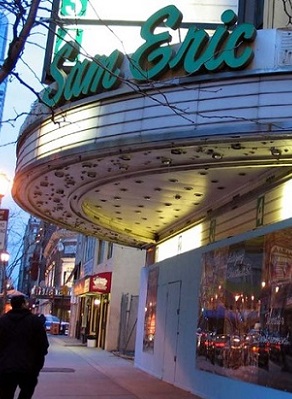
The Boyd Theater (1930s) / The SamEric Theater (1980s)


     Hmmm? While that VAULTED TREASURES subtitle above always says "Movies you never knew about, you forgot, or you forgot to love more the first time around", this one will be a slight (let's call it) "Electric Slide" sidestep or two to the left by maybe replacing the word "movies" with "theaters".  I'm gonna try not to be all "age-i-fied" on this one. Y'know, try not to make this one of those postings which begins with "You may have to be over 30 to appreciate this". But the truth is, ehhh ... you kinda just may have to be! Jeez, sorry! But hear me out before you get that look on your face, oh "Dear Person Younger-Than-Me", because I'd be willing to bet next month's rent that you've got one of these too somewhere in your past. Maybe not the exact same kind of "one of these". I mean, I've spoken to those who had a particular video store which became the creative "trysting place" of their formative youths. Or a record shop, or book store, or comics shop, or long defunct arcade, etc. which sparked their interest in some form of the creative arts. But you've got one. And I defy you not to get nostalgic and corny and all when flashing back to it and the (no exaggeration to say) maybe life defining times you had during your "back in the day" there.

Mostly no-longer-existent 1980s - 90s era "Trysting places of the arts" as
depicted in film (top to bottom): The record store - HIGH FIDELITY (2000) /
comic book shop - UNBREAKABLE (2000) / video store - BE KIND REWIND (2008)

    At any rate I posted something on Facebook yesterday about noticing increasing gray hairs on my head. And perhaps this is just another rendition of the same thing - the much smaller scale written version of how Terry Gilliam's wife once playfully accused him of making the same movie over and over and over again. And if you really think about it, she's right. Look closely enough at BRAZIL, BARON MUNCHAUSEN, THE FISHER KING, 12 MONKEYS and others, and there's a very striking (I wouldn't call it "sameness", but) thematic similarity running through the central nervous system of them all. And I guess this is kind of along the same part and parcel lines as the "reflecting back and noticing things as you get older" nature of the "gray hairs" thing. In fact like the "gray thing" this too started as a social media posting - just one which got way too damned long, so it was placed here. People will tend to click away from a long social media posting but will often be more inclined to read a short blog, ... even if that blog posting is in actuality longer than the social media one. Go figure, huh? But I've digressed enough. On to it ...

One more movie stills digression with "three according to Gilliam" (L to R) BRAZIL (1985),
THE ADVENTURES OF BARON MUNCHAUSEN (1988),12 MONKEYS (1995).
Okay, now we can continue ... 

     A Facebook friend in Chicago made comment this weekend about the love of Windy City fans for The Uptown Theater, and how they hope it can be saved from the wrecking ball. And it brought memories flooding back ... . Well, "flooding back" isn't really accurate as the memories are still vivid, and a very important part of my life (creative and personal) to this day. We had a magnificent theater like that in Philadelphia - a gorgeous art deco palace at 19th & Chestnut Streets in Center City. When it opened in 1928 it was called The Boyd Theater. Films like GONE WITH THE WIND, THE WIZARD OF OZ and others had their premiere runs there; it was one of the original 3-strip Cinerama theaters in the nation; and it was the premier tri-state area (Philadelphia, South Jersey, Delaware) 70mm Roadshow palace as well - with BEN-HUR (Chuck Heston showed up in person on opening night), DR. ZHIVAGO and others running there in their original formats.

(top) THE TEN COMMANDMENTS (1956) - 70mm screen grab,
(bottom) STAR WARS: THE EMPIRE STRIKES BACK (1980) - 70mm cell scan

     In 1971 The Boyd was taken over by a local chain called SamEric Theaters, which has since been taken over by The Regal Entertainment Group - the owners of Regal Cinemas, Edwards Theaters and United Artist Theaters. And that's where and when my personal love of the place grew as it was the largest screen in three states for quite some time while I was growing up. To this day I've been to IMAX theaters which couldn't hold a candle to a great 70mm print at the SamEric. Even when I lived in South Jersey, and a film was playing at the local mall not far away, I'd take the bus or (later when I got my license) drive 20 to 30 miles to see it at "The Eric" (that's what the locals called it) or "At 19th & Chestnut" (it's former pre-GPS film fan designation) just because of that screen and that ohhhh-so-immersive wraparound sound.

The Boyd (later SamEric) lobby

     To this day I've fond memories of seeing THE EMPIRE STRIKES BACK, RAIDERS, TEMPLE OF DOOM, A VIEW TO A KILL, THE LIVING DAYLIGHTS, an awesome all day STAR TREK film marathon and more at the Eric. And I always regretted not being able to see SUPERMAN: THE MOVIE or TRON in their original 70mm runs there. And, oh yeah, films like Jonathan Demme's 1993 drama PHILADELPHIA had their world premieres there too.

     When multiple screens became all the rage (and an economic necessity), instead of chopping up it's gorgeous main theater, the SamEric group actually sprung the mega bucks to knock down a lobby wall and add a new annex onto the existing building with three smaller screens. Hell yeah! But of course as such when something like RETURN OF THE JEDI, OCTOPUSSY or INDIANA JONES AND THE LAST CRUSADE opened and was playing on the main mega-screen and one or two of the other screens (and back then it was the same admission price for all of them) it was incumbent upon you to know which times were for which of the four theaters.

     One of the things I most loved about The Eric / The Boyd (but not everyone did) was what a "chameleon"-like theater it was in the 1980s - 90s. Depending on what was playing (and what day and / or time of day you went) The Eric was the place for a night out with family or with a date, or it was the slightly grander scale version of a grindhouse theater in all it's heyday glory, but with a seven or so hundred (rather than two or three hundred) strong crowd hurling comments at the screen, ... and sometimes in unison.


     I remember how on the Friday night I saw COMING TO AMERICA there with a date it was more a multi-ethnic / multi-age "family night out" kind of crowd - with everyone lined up at the ice cream shop across the street before and after each show. And how on other Friday nights or Saturday afternoons films like THE SERPENT AND THE RAINBOW, CHILD'S PLAY, THEY LIVE, FATAL ATTRACTION, SCREAM and others turned it into the biggest "interactive shout at the screen" fest outside of THE ROCKY HORROR PICTURE SHOW and Times Square New York of the 1980s. As said, some patrons didn't dig the (at times) schizoprenic nature of The Eric. But if you loved EVERY KIND of film (and I always did) it was a stone cold blast. And yeah, sometimes "stoned" was the operative word as many in the audience were unequivocally convinced that was the only state to be in in order to watch certain kinds of films. Hey, life in big city, huh?

The ghost of The Boyd / SamEric after shuttering its doors in 2002

     To this day I believe part of the "group psychology of enjoyment" inherent and at work at The Eric was that - not unlike with an old school Vegas magic act before it begins - the theater had these huge heavy dark red velvet curtains which would open (and once or twice done so manually by two guys on stage when the motor was on the fritz) as the theater lights dimmed. There was something magical about that. You could feel the rise in expectation within the audience, especially when they all started cheering and clapping and hootin' and hollering when it did. Then if the film itself had some kind of recurring, recognizable and beloved cinematic opening - like the James Bond gun barrel or the STAR WARS "A Long Time Ago In A Galaxy Far Far Away" prologue - ohhh, Mama! - there was a deafening cheer as the audience went 100% total and complete absolute bonkers apesh*t. And that was more infectious than the ebola virus.


     Hell, the truth is that some films (CHILD'S PLAY 2 anyone?) were made 10 times more enjoyable by just seeing them in that particular theater and with a particular audience - one which was just "into it". And to this day when I'm writing a script, and looking for a "vibe", or if I'm attempting to describe what "kind" of a film I'm envisioning to someone, I'll often refer to it as a "19th & Chestnut movie", then I'll explain why, and they totally get it.

     The last film I saw at The Eric / The Boyd before it closed was 1998's X-FILES: FIGHT THE FUTURE. And after it brought those velvet curtains together for the last time there was a fifteen + year effort by many to have the theater designated an historical site in order to save and preserve it. But to no avail.

     I truly hope Chicago's beloved Uptown Theater can be saved from the ball and preserved - as I hear Joliet's The Rialto (about an hour outside of town) managed to be - because, as much as I truly love today's IMAX venues and digital sound and all, there's still nothing quite like watching a movie in a grand ol' cinemadrome like The SamEric / The Boyd. Tom Hanks was even blown away by the place during the Philadelphia World Premiere of the movie PHILADELPHIA in 1993 - surprised and excitedly exclaiming, "Wow! A real movie palace!".

     Hell, in places like that even going to the bathroom, or stepping out into the lobby to get a refill of popcorn, was a hell of a theater-going experience.

     See 'ya in the balcony. And, hey, no hanky panky up there.  The ushers with the flashlights are watching.  ;)


                                                                                                                  CEJ

More on The Boyd / SamEric Theater @

* CINEMA TREASURES.ORG: http://cinematreasures.org/theaters/1209

* CURBED PHILADELPHIA: https://philly.curbed.com/2015/3/16/9980704/lets-take-one-last-look-back-at-phillys-art-deco-palace

* MENTAL FLOSS.COM - "15 Eerily Beautiful Photos Of Abandoned Movie Houses": http://mentalfloss.com/photos/91024/15-eerily-beautiful-photos-abandoned-movie-theaters?fbclid=IwAR3jtHbJXh3p27UhSmzoykNLE-K8xnfQR0uNu_ixJ2ltoxha06ZNpjPwkWI

________________________________________________

Vaulted Treasures is part of The GullCottage / Sandlot - a film blog, 
cinema magazine, growing reference library and online network 
"Celebrating The Art of Cinema, ... And Cinema As Art"

Explore The GullCottage / Sandlot @