Saturday, January 17, 2015

THE SECRET ADVENTURES OF JULES VERNE (2000)

TRIBUTE TO THE FATHER OF STEAM PUNK, ... BEFORE THERE WAS SUCH A THING


VAULTED TREASURES:
HARD TO FIND FILMS
WORTH SEEKING OUT

     Streaming is wonderful, but many cinematic gems (for various reasons) have yet to make the leap to NetFlix, Hulu, Blu-ray or even DVD. In fact some have never been released in ANY home video format. And for this reason we saved our old school VHS tapes / players and DVD burner; and love to return "to the vaults" to relive old faves.

     Usually by the time a movement (literary, artistic, political, what have you) has been christened with an official title, that movement has already run it's course, and all you get from that point on are pale and stale impersonator / wannabees "cashing in" on the hard-fought-for innovations of said movement's originators. Some might say it was such for "Steampunk" - that "mashed up" (long before THAT phrase was coined) literary / filmic offshoot of William Gibson-esque "Cyberpunk" - wherein high technology (flying machines, weaponry, submersibles, super computers, etc.) are used in an alternate reality timescape (say circa the 1880s American West, Victorian England or post apocalyptic future), but powered by said era's romantically archaic means: e.g., steam, coal, compressed air pressure or whatever.

     And while the works of Philip Pullman (NORTHERN LIGHTS - aka "THE GOLDEN COMPASS") and Stephen Hunt (referred to as "Charles Dickens meets BLADE RUNNER") still make bestseller lists ... . And while even corporations such as Prada, Versace, and Dior have dabbled in Steampunk-ish fashionista lines on occasion, the decade of the 1990s is largely considered by many to have been the movement's cross-cultural / crossover "Golden Era". That is unless your name is Jules Verne.

     Cited with H.G. Welles and Hugo Gernsback (after whom literature's "Hugo Awards" are named) as one of the three founding "Fathers Of Science Fiction", Jules Verne (1828 - 1905) arguably stands alone as the creator of the "Steampunk" genre, ... once again long before it occurred to anyone to call it such. Still lauded as one of literature's most scientifically "prophetic" authors (as his pen would foresee the airship, submarine, space travel and more long before their real world realizations), he was also given to political commentary in the midst of such whallopingly hair raising classic adventures as AROUND THE WORLD IN 80 DAYS, 20,000 LEAGUES UNDER THE SEA, MYSTERIOUS ISLAND, TWELVE WEEKS IN A BALLOON, JOURNEY TO THE CENTER OF THE EARTH, MASTER OF THE WORLD and many more.


     That Verne "triple threat" of sci fi, adventure and politics would briefly coaleasce into one of the most intriguing, and intriguingly realized, television series at the beginning of the (then new) 21st century - the very short lived THE SECRET ADVENTURES OF JULES VERNE. The brainchild of writer Gavin Scott (THE MISTS OF AVALON, SMALL SOLDIERS), it's first (and as it turned out ONLY) season of 22 episodes was cleverly pre-sold for syndicated airing in primarily Canada and the U.S. But as it was a truly independently financed venture, it would never recoup it's hefty production costs to the point of allowing the filming of another season let alone any kind of DVD, Blu-ray, streaming or other home video release for which many fans are still clamoring and chomping at the bit.

     Assuming he'd enter the successful law profession of his father, the family of young Jules Gabriel Verne was shocked when, after his first years of study in Paris, he detoured into the artistic world of the "literary salons" where he'd became good friends, and a writing collaborator, with Alexander Dumas fils, the son of THE THREE MUSKETEERS / THE MAN IN THE IRON MASK author Alexandre Dumas. Together they'd debut a play at the Paris' Opéra-National Théâtre Historique, and this would be Verne's entre into a full time writing career; the bulk of his most popular works then to fall under the thematically encompassing umbrella of the "VOYAGES EXTRAORDINAIRES" (the "Extraordinary Voyages") - a sequence of fifty-four novels published between 1863 and 1905.


      A life long research, science and technology (hey, proudly call Verne what he was) Victorian era "geek" (long before THAT phrase was coined), the dual intent of the VOYAGES was (in the words of Verne's editor / publisher) "to outline all the geographical, geological, physical, and astronomical knowledge amassed by modern science and to recount, in an entertaining and picturesque format, the history of the universe." This Verne would do with some of the most famous, and said earlier, "prophetic" and popular stories in the history of published literature - he today holding the title of the "2nd Most Translated Author Of All Time", sandwiched between #1 William Shakespeare and #3 Agatha Christie, ... two more of our personal GullCottage faves, by the way.


     Interestingly, with the possible exception of 20th Century Fox's 1959 big screen rendition of JOURNEY TO THE CENTER OF THE EARTH, while making the transition to film in classics such as Disney's 20,000 LEAGUES UNDER THE SEA (1954), Ray Harryhausen's MYSTERIOUS ISLAND (1961), American International's MASTER OF THE WORLD (1961), and even to a degree, in the 1956 David Niven adventure / comedy AROUND THE WORLD IN 80 DAYS, Verne's political subtext - very often of an anti-war / anti-aristocracy nature - would remain intact. It was this "political element" which gave SECRET ADVENTURES series creator Gavin Scott his first spark of inspiration. In the series' eventual promotional packet he'd recount:

     “I first came up with the idea of putting Jules Verne at the center of his own adventures when I discovered that he had originally written 20,000 LEAGUES UNDER THE SEA because he was furious at the Russian invasion of Poland. Suddenly it came to me… what if there had been more reality behind the Jules Verne fantasies than we even knew? And what if I wrote a series of stories which revealed the true adventures behind 20,000 LEAGUES, AROUND THE WORLD IN 80 DAYS and JOURNEY TO THE CENTER OF THE EARTH, then added to these stories some of Verne’s actual contemporaries – noted figures as diverse as Mark Twain, Queen Victoria, and Frank and Jesse James!”

Showdown with the robotic gunslinger "Steely Joe"

     Scott would elaborate on that initial thematic inspirational tidbit by recollecting how in real life Verne's publisher convinced the author of the need to "cloak" the real-world personalities of his stories behind the mask of a fictitious characters so as to a) not risk foreign sales, and b) avoid international incidents between nations by making certain personages either villainous or heroic. In other words, Verne would "change the names to protect the innocent ... and the not-so-innocent". Using this as a launching pad, Scott's fertile and facile imagination concocted an "alternate" version of many of Welles' stories. There would be the fictitious "sanitized" version which Verne had given to the world by way of his popular books, and there would be the secret "X-FILES"-like version of "what really happened"; this only now coming to the attention of the public in the form of the prospective new series. As every writer / artist knows however, it's far easier to imagine a clever product / series / film than it is to execute one.

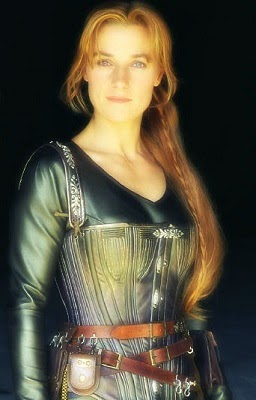
     In Scott's "secret files" version of Verne's adventures the titular author (in the series portrayed by DREAM ON's Chris Demetral) would remain a young up-and-coming writer in Paris. But here he would be plucked from a pre-fame nothing existence, and taken under the tutelage / protection of AROUND THE WORLD IN 80 DAYS' globe-trotting Phileas Fogg (DYNASTY and ROBIN OF SHERWOOD's Michael Praed) who here is far removed from the David Niven-esque clubland's adventurer, and realized more as a "flawed James Bond"-like former British Intel operative. Reimagined by Scott, Fogg's valet / manservant Passepartout (Canadian mime / comedian Michel Courtemanche) would become a "Q"-like gadget master / inventor - with our team's base-of-operations, the dirigible the "Aurora" being his greatest accomplishment. And the adventurers would be accompanied by the ever resourceful Rebecca Fogg, Phileas adopted cousin, and the first female agent of England's Secret Service (played by actor, dancer, swimmer and fencing master Francesca Hunt).

"Steely Joe"'s papa: Illustrator / Concept Designer Meinert Hansen

     A LITERAL as well as literary "visionary", in the series young Verne is unaware that he is in possession of a mental gift which allows him to psychologically cross time and actually see into the future; hence the numerous prophetic yet-to-come technological renderings in his stories. Wanting to possess Verne and his gift, which can bestow upon them an arsenal of future tech / world-conquering weaponry, is the League Of Darkness, lead by Count Gregory (WILLOW's Rick Overton), an international organization of terroristic aristocrats who believe the way to keep the "common masses" in check is to insure volatile world conditions (civil war, revolution, etc.) wherein said masses will then beg for the care and leadership of that privileged elite.

     Scott's concept having much interest, the gathering of actual funds to realize the series was considerably more difficult to achieve. After spending years independantly obtaining backers in the U.S., England, Germany and Canada - where tax incentive credits would lead the production team to convert a defunct rail station into a period-dressed 100,000 square ft. soundstage - production began on the 22 episode first season of THE SECRET ADVENTURES OF JULES VERNE. And this was done even before the series had a broadcast deal / schedule in place!


     The first one hour series to be filmed entirely using the (then) new HDTV recording system, SECRET ADVENTURES suffered visually in that, eventually picked up by CBC / Space in Canada, and the SciFi Channel (later SyFy) in the U.S., at the time neither network was broadcasting in HD. Therefore the episodes were downconverted onto film, and as such much of the detail of it's exquisitely realized costumes, production design, cinematography and visual FX took on a distractingly dark and "muddled" quality when first aired on standard television.

     This didn't deter a wave of fans (us included) who immediately latched onto the series' considerable wit, style and visual and intellectual creativity. With impressive guest stars such as SHOGUN and THE LORD OF THE RINGS' John Rhys Davies as Alexandre Dumas, SUPERMAN's Margot Kidder, DALLAS and THE MAN FROM ATLANTIS' Patrick Duffy, along with Michael Moriarity, Mako, David Warner and more, the Victorian era set SECRET ADVENTURES OF JULES VERNE globe trotted from European adventures such as "Queen Victoria And The Giant Mole", "The Cardinal's Design" (which featured a pre DA VINCI CODE-like mystery), "Rockets Of The Dead" (with a Carpathian arms dealer Count actuall discovered to be a vampire who seeks to equip his blood sucking army with jet packs for world conquest), to a MYSTERIOUS ISLAND / ROBUR THE CONQUEROR-inspired multi-episode arc set in the midst of the American Civil War, with the standout installment undoubtedly "The Ballad Of Steely Joe" - wherein our heroes meet Frank & Jesse James, Samuel Clemens (aka "Mark Twain"), and a robotic quick draw gunslinging town "Sheriff".


     At $2 million per episode (approx. $40 million for the first season), THE SECRET ADVENTURES OF JULES VERNE had too many creditors of a multi-national composition, and not enough broadcast outlets at the time (in addition to CDC / Space Canada and SciFi, it was carried by but a few other syndicated outlets worldwide) to recoup it's substantial investment. As any future distributor wishing to revive or release the series on DVD, Blu-ray or streaming platform would first be required to take on, then pay off, any contractual and other obligations, the show today remains in legal limbo, and exists only in homemade VHS copies recorded by fans during the series' initial TV run.

     This is how we've been enjoying THE SECRET ADVENTURES OF JULES VERNE for the last 15 + years, although the common sense need for preservation has since lead us to transfer all 22 episodes to DVD-R and the digital realm. Others have also done so. And some of those efforts can today be viewed via condensed versions of selected episodes on YouTube, and even via a bootleg European import DVD of the complete First Season. Although, as with other "independent" DVD releases we've discussed in Vaulted Treasures, we can neither vouch for said discs' quality or ability to play universally on all machines.

     Until a magical (or high tech) key unlocks the financial destiny of THE SECRET ADVENTURES OF JULES VERNE, the series' promotional byline "Inventing the future, ... Battling to save it", has in recent years become much more than a cleverly realized tag. It, like the works of Verne himself, has become ... here's that word one more time, "prophetic".

  
                                                                                                                             CEJ

________________________________________________

Vaulted Treasures is part of The GullCottage / Sandlot - a film blog, 
cinema magazine, growing reference library and online network 
"Celebrating The Art of Cinema, ... And Cinema As Art"

Explore The GullCottage / Sandlot @

Copyright © 2015 Craig Ellis Jamison. All rights reserved.

DOC SAVAGE: MAN OF BRONZE (1975)

TONGUE IN CHEEK IS SERIOUS BUSINESS


VAULTED TREASURES:
HARD TO FIND FILMS
WORTH SEEKING OUT 

     Streaming is wonderful, but many cinematic gems (for various reasons) have yet to make the leap to NetFlix, Hulu, Blu-ray or even DVD. In fact some have never been released in ANY home video format. And for this reason we saved our old school VHS tapes / players and DVD burner; and love to return "to the vaults" to relive old faves. 

     "Tongue in cheek" is serious business, ... and it ain't easy. And perhaps therein lay a seminal ingredient of the "cult film". One thing is for certain, no one can really SET OUT to deliberately create a cult film, as by it's very definition there is something "contrary" in it's makeup; in it's very fiber. Yes, you've got deliberately "off-center" films like Luc Besson's THE FIFTH ELEMENT, John Carpenter's BIG TROUBLE IN LITTLE CHINA, and (who ever thought we'd see the day when THIS would become hip?) Dino De Laurentiis' FLASH GORDON. But they were all more or less created as grand scale pulp-ish adventures possessed of an iconoclastic / at times intentionally campy sense of humor and disposition. 

     They were films which achieved cult STATUS. But the straight-up, bonafied, dyed-in-the-wool cult film ... ? Well, just as a stereotypical cult of chanting lunatics beholden to a philosophy which just seemed to crop up yesterday afternoon down by the lake, are viewed askew by polite society at large, so were / are those who for years felt / feel a deep emotional and (even ... "gulp") artistic affinity to something like say THE ROCKY HORROR PICTURE SHOW, REPO MAN or THE ADVENTURES OF BUCKAROO BANZAI, viewed askance by most cinematic "arbiters of good taste".

      While there is no "dictionary definition" of what constitutes a bonafied cult film, two of the most commonly occurring threads are surely a) that regardless of subject matter, they tend to play their narratives with a straight face. There may be some camp, yes. But they don't constantly wink at the audience in a post-modern manner, reminding you that this IS camp. No. The audience must be "in the know" enough to realize this is indeed not to be taken too seriously. And b) most cult films were / are generally during their original theatrical runs box office failures. And this is usually BECAUSE of definition a) - wherein the audience was NOT "in the know" enough to "catch the joke played with the straight face"; and the film was perhaps then misinterpreted as a poor realization of a drama, love story, science fiction yarn, adventure or what-have-you. 


     Years later, after seeing the film again and again at late night revival house screenings, or on cable TV, at home on video, etc., some of it's originally negative audience "catches on", catches up and realizes the "in"-ness of the earlier joke, and they too slowly begin to join the ranks of those original crazy-assed "chanting lunatics" who from the git-go sang the praises of said film. Before you know it even critics and cinema historians begin having a differing view of that which was originally written off - that film now being referred to as, ... what are some of the most common terms? - "cutting edged" and (perhaps the most oft repeated critical accolade) "ahead of it's time". Which brings us to 1975's DOC SAVAGE: THE MAN OF BRONZE.

      The last produced film from legendary celluloid genre king George Pal (WHEN WORLDS COLLIDE, WAR OF THE WORLDS, THE TIME MACHINE), directed by Michael Anderson (AROUND THE WORLD IN 80 DAYS, LOGAN'S RUN), and starring Ron Ely - TV's TARZAN himself, as the titular scientist, adventurer, explorer and international trouble shooter, DOC SAVAGE: THE MAN OF BRONZE (to date the only feature representation of literature's best loved "pre Indiana Jones" treasure-seeking enemy of evil), began on the drawing boards with a bang. But released theatrically within days of summer 1975's genre busting JAWS, it quickly sank at the box office - the chewed remains of a great white shark which, in the super cynical days of Watergate and Love Canal, was not then seen as cleverly hip in it's (actually rather quick witted) counter-culture re-shuffling of themes of justice and honor, but actually deemed quaint and hopelessly out of date; one critic at the time calling it, "... the kind of kiddie film that gives the 'G' rating a bad name".


     Lo and behold however, within a few short years the similarly themed and tonally executed SUPERMAN: THE MOVIE, STAR WARS and RAIDERS OF THE LOST ARK, would cause a re-evaluation of Pal and Anderson's pulp adventure. Those who found themselves enjoying the new "retro" filmic adventure trend spawned by those box office behemoths, grew impatient awaiting the next installment of the adventures of Luke & Han, Indy, and Krypton's most famous son; and they began their own cinematic archeological digs; in the process discovering DOC SAVAGE, and in time granting it due honorable shelf space alongside those Lucas / Spielberg and other serial inspired "throw back" movie thrill rides. Even noted film critic / historian Leonard Maltin would sing DOC SAVAGE's praises. But we're getting ahead of ourselves.

      While 1975's DOC SAVAGE to date remains the only feature length film representation of the "Man of Bronze" (this moniker because of the famously sun-baked tan across his super muscular anatomy), the character has been the subject of dozens of pulp novel, radio, comic book and other media series since his inception in 1933. The brainchild of Street & Smith publications - who wanted another pulp hero to follow on the heels of their then extremely successful THE SHADOW, the DOC SAVAGE character as we currently know him was ultimately fleshed out from the pen of former telegraph operator, and self taught writer, Lester Dent, who wrote approx. 160 of the first 180 original SAVAGE pulp novels under the Street & Smith "house name" pseudonym of "Kenneth Robeson". A 1930s era Rennaisance man: surgeon, explorer, inventor, scientist and musician, Clark Savage Jr. (our hero's birth name) was a super-hero without standard super powers. His brain his mightiest weapon, he possessed a photographic memory, was a master of disguise and the martial arts, and used his supremely gifted and disciplined mind to train his body to perform feats of near-superhuman strength.  


     Accompanied on his adventures by "The Fabulous Five" - a cadre of individual geniuses in their own rights (a geologist, chemist, two engineers and an attorney?), Doc owns a fleet of vehicles for air, water and all terrain travel; and he and his crew reside on the 86th floor an un-named New York City sky rise which readers of many of the later novels came to believe was the Empire State Building. And oh yes, the financial wherewithal to fund all of this came from (of course) a Central American gold mine given to Doc in the very first novel as a gift of gratitude by a group of Mayan descendants. Amazingly also, over the years many of the "steam punk"-like high tech inventions used by Doc (and even some of his villainous adversaries) became actual technological realities: things we take for granted today such as night vision goggles, automatic transmissions in autos, telephone answering machines, and even the (though now actually history) "flying wing" aircraft.

      A new generation of DOC SAVAGE fans (us among them) was born with the re-issues of the original pulp novels in paperback form by publishing giant Bantam Books during the 1960s. Remaining in print for over two decades the quintessential, and still defining, look of the "Man of Bronze" became the ripped shirt (caused by Doc's ripped musculature) rendition on these book covers realized by legendary "Argosy" / "Saturday Evening Post" illustrator James Bama; he using 1950s FLASH GORDON tv actor Steve Holland as model.


Illustrator James Bama's DOC SAVAGE

     After the death of primary DOC SAVAGE author Dent (who retained radio, TV and film rights), his estate (headed by his widow Norma) licensed the character for a 1966 / '67 feature film based on the 1934 novel THE THOUSAND HEADED MAN. Produced by Mark Goodson & Bill Todman (best known as creator / producers of the game shows PASSWORD, TO TELL THE TRUTH and THE PRICE IS RIGHT) it was to star THE RIFLEMAN's 6ft.5 Chuck Connors - who, before his acting career, was one of only a handful of athletes to play professionally for both the MLB and NBA. Because of his height and sports conditioning Connors was a physical dead-ringer for Doc. And the producers intention was to cash in on both the new character interest generated by the Bantam re-issues, as well as on the current pulp-inspired James Bond films of the day, 

     Goodson and Todman were confident their rendition of Doc would ignite the screens to great success. Their version however would never come to pass. Science fiction producer George Pal secured the character rights from the widow Dent in the early 1970s, and he, also desirous to start a Bond-like film franchise, sought to financially hedge his enterprise using a funding tactic similar to one enacted by producer Irwin Allen on his film VOYAGE TO THE BOTTOM OF THE SEA, wherein "back end" costs would be covered by pre-selling the TV broadcast rights to the film as well as rights to a future TV series.


     Under the helm of director Michael Anderson, DOC SAVAGE: THE MAN OF BRONZE filmed in mid to late 1973 in Southern California, with more than a bit of the film's stunning neo deco production design realized via shooting on actual locations such as the base of the Eastern Columbia Building in L.A.'s historic downtown (then) theater district. Scripted by Pal and Joe Morheim (at the time best known for the TV series THE MILLIONAIRE and THE SAINT), DOC SAVAGE: the MAN OF BRONZE was primarily adapted from "Kenneth Robeson"'s first novel, wherein Doc's backstory is established, with additional material from 1935's THE MYSTIC MULLAH and 1938's THE GREEN DEATH. The 6ft. 4 Ron Ely threw himself into the role. Known for performing most of his own stunts in the TARZAN tv series (which lead to two broken shoulders, various animal bites and other sundry injuries), in DOC SAVAGE he'd additionally take up the baton of Second Unit Action Director, helming a couple of the film's key set pieces including the shootout aboard the yacht of the villainous Captain Seas.

      The release troubles of DOC SAVAGE began before it's release. Pushing back it's original debut date from Spring 1974 to early Summer 1975 was seen by many as a lack of confidence in the film by it's studio, Warner Bros. And this arguably prejudiced opinions as to the film's quality long before it was viewed by critics. Opening within days of the mega-smash JAWS, SAVAGE's more old fashioned tone of Saturday matinee "innocence" was blown to bits by the high powered caliber and execution of Spielberg's at the time (call it was it was) frenetically edited re-invention of the concept of the modern film. And because DOC SAVAGE played it's hand straight (without loads of campy winking at the audience to remind them of how hip it really was) it's tone was greatly misinterpreted by audiences. 


     There was even (and continues to be) a great deal of talk (the early version of "Internet scuttlebutt" before the creation of the Internet if you will) with many asking "Who was to blame for DOC SAVAGE's campy realization - George Pal, Michael Anderson, or a post-production meddling studio?". Film critic Leonard Maltin perhaps summed up best the film's actual tone in his assessment saying, "(This) film debut of Kenneth Robeson's pulp hero was sold (and accepted) as camp; where in reality it's a straight faced period adventure that just came out at the wrong time".


      And we couldn't agree more. While certainly possessed of an occasional "camp" element (it's endearingly rollicking John Phillip Sousa-inspired and adapted score; and the animated twinkling in Doc's eye upon first meeting the lovely Pamela Hensley - later of BUCK ROGERS IN THE 25TH CENTURY and MATT HUSTON, are a hoot), it certainly doesn't devolve into the practice much more than say the average Indiana Jones film. Yet opening in the midst of a more cynical "anti-hero" wave populated by the likes of DEATH WISH, FRENCH CONNECTION II and SHAFT IN AFRICA, DOC SAVAGE's more "old school" sensibilities were at the time unfortunately not seen as "hip retro" as much as "out of date" and "hackneyed". 

     Had the exact same film opened three years later one wonders if it may not have been considered part of the "new wave" movement towards more larger than life, archetypal-like cinema as evidenced by the successes of SUPERMAN, SUPERMAN II, STAR WARS, RAIDERS and even the more pulpish Bond films THE SPY WHO LOVED ME and MOONRAKER. Those "cult members" who fell in love early with the charms of George Pal's filmic rendition of Robeson's hero, were heartbroken that, even though just before the end credits, they were promised Doc would return in an all new thriller - THE ARCH ENEMY OF EVIL, poor box returns did what no villain could in close to half a century - put Doc out of commission, at least on film.


     While Joe Morheim had scripted a follow-up film (which can today be found online), Pal's days with DOC SAVAGE ended with the 1975 film; and the legendary producer himself would pass away five years later in May 1980. DOC SAVAGE: THE MAN OF BRONZE was first released by Warner Home Video on VHS in the mid 1980s in a "clamshell" - the large plastic cases denoting a family film (and so packaged as to keep the tape within from being destroyed by playful children). At this time it would also enjoy release on the now defunct LaserDisc format. Both editions have been long out of print. 

     In 1994 Warner re-released the film with standard VHS packaging; and copies of this version - while also long out of print, can today be found on Amazon and other outlets ranging from $3 - $12 dollars. All of these releases were in the "Pan & Scan" display format. In 2009 however, the film was made available for the first time on DVD in the U.S. via a limited release as part of Warner Home Video's DVD-R "pressed upon demand" Archive Collection. Nicely re-mastered this is the best DOC SAVAGE has looked and sounded since it's original theatrical debut. In recent days the film has also been made available to rent or buy digitally via Amazon Instant Video.


      As for the future of DOC SAVAGE in the movies? The character's increasing popularity (since 1966 there have been seven different comic series from Gold Key, Marvel, D.C., Dark Horse and more; it was Doc Savage and not Howard Hughes who invented the jet pack in Dave Stevens' original THE ROCKETEER graphic novel; and BUCKAROO BANZAI AND THE HONG KONG CAVALIERS were the 80s hipster version of Doc and the Five) has kept him in the crosshairs of not only his enemies, but those of tinsel town as well. In 1999 screenwriter / director Frank Darabont (THE SHAWSHANK REDEMPTION / THE MIST) and screenwriter / director Chuck Russell (THE MASK, ERASER) intended to bring a new version of DOC SAVAGE to multi-plexes with a grand scale adventure starring Arnold Schwareneggar. But the actor's ascension to the Governor-ship of California pulled the plug on that rendition. 

     In 2013 it was announced that writer / director Shane Black (LETHAL WEAPON, KISS KISS BANG BANG, IRON MAN 3) was given the green light on a new big screen Doc yarn. And, as per the novels, Black's version is to take place in the 1930s.  He wants everyone's fave hero to be accompanied by his ever present "Fabulous Five". And it's also said the present day cinematic pulp-maestro wants none other than THOR's Chris Hemsworth for the lead.

We'll keep you posted. Until then ...

"Tune in next week for another exciting episode"! 


                                                                                                                           CEJ

________________________________________________

Vaulted Treasures is part of The GullCottage / Sandlot - a film blog, 
cinema magazine, growing reference library and online network 
"Celebrating The Art of Cinema, ... And Cinema As Art"

Explore The GullCottage / Sandlot @

Copyright © 2015 Craig Ellis Jamison. All rights reserved. 

Friday, January 16, 2015

KAFKA (1991): A little TOO Soderbergh, ... Even for Soderbergh! - by CEJ


VAULTED TREASURES:
HARD TO FIND FILMS
WORTH SEEKING OUT

(revised 4/8/18)

     Streaming is wonderful, but many cinematic gems (for various reasons) have yet to make the leap to NetFlix, Hulu, Blu-ray or even DVD. In fact some have never been released in ANY home video format. And for this reason we saved our old school VHS tapes / players and DVD burner; and love to return "to the vaults" to relive old faves.

     Some films are perhaps just too experimental and deliberately vague / "Rorschach"- like (or maybe ahead of their time) to be understood, ... even by their makers. After winning the Cannes Film Festival's Palm d'or for his 1989 breakout hit SEX, LIES AND VIDEOTAPE - and at age 26 becoming the youngest director to do so, Steven Soderbergh went on to be lauded as (Roger Ebert's words here) the "poster boy of the Sundance generation", and, along with a handful of others at the time such as Spike Lee and Wayne Wang, was credited with helping to launch the modern independent cinema movement. Eagerly courted by studios large and small, filmdom's fans (and industry execs) eagerly anticipated the wunderkind's next cinematic endeavor. Then when KAFKA hit theaters on November 15th, 1991 there was a resoundingly loud world-wide collective "Huh?" accompanied by quite a bit of head scratching.

     To say KAFKA was a box office disappointment is an understatement. With a budget of $11 million (a hefty price tag for an independent film - in this case funded by the still fledgling Miramax in conjunction with Barry Levinson's Baltimore Pictures) it barely broke $1 million in ticket sales. Critics were split down the middle; and not in the sense that half liked it and half didn't. But in the rare sense that almost every critic both liked AND hated it, or at least certain elements. Many questioned why Soderbergh would choose as his sophomore effort something thematically so far removed from the intimate Eric Rohmer-esque nature of SEX, LIES. And while Soderbergh defended his position, saying he'd ALWAYS been drawn to this kind of film making, and that SEX, LIES was actually the departure for him, he would later publicly state that perhaps KAFKA was indeed a career "misstep"; and even today he talks of revamping it completely. Wow! Now, for those who "came in late" and are not familiar with this intriguing (if yes, somewhat indecipherable - it does beg repeated viewings) little gem, here's a little primer.

 
     In Prague of 1919, Kafka (a fictitious amalgam of Kafka characters "Joseph K", "Gregor Samsa" and the writer himself; ... and here portrayed by Jeremy Irons) works a life-sucking existence as an insurance claims cipher by day, but let's his imagination loose by night via the spinning of stories the world will come to recognize as being from the author's famous pen. When a co-worker mysteriously disappears, Kafka seeks answers and is plunged into a dark, disturbing (and very funny) web of intrigue involving a possible police cover up, politics, and a group of bomb planting anarchists who insists a conspiracy is afoot ... though they have nothing but their own paranoia on which to base their theory. Kafka's personal investigation allies him with his missing co-worker's mistress (Theresa Russell), and leads to his piercing the walls of the macabre "Castle" overlooking the city, to where it seems many street innocents have been dragged for human experimentation.

     Close thematic, visual and tonal kin to Terry Gilliam's earlier BRAZIL, David Cronenberg's later NAKED LUNCH and Alex Proyas' DARK CITY, screenwriter Lem Dobb's fashioned KAFKA the film as sort of his own version of Cronenberg's "Brundle-Fly" - wherein the DNA of two very different beings are merged to create a third. In this case feeling it was impossible to faithfully adapt a Kafka story to the screen, he took literary DNA samples (so to speak) from various works by the author, combined them with references to the author's actual life, then stirred them together into a new narrative all his own. And we've always loved it.  It's certainly not for all tastes. And as stated earlier one has to watch it more than once to start peeling away it's layers of socio-political brilliance - especially it's satirical humor aimed squarely at conformist mentality. But for those who don't mind putting a little "brain work" into their cinema viewing, KAFKA is a visually stunning work of art, and a 24 fps thesis paper on bravura filmmaking technique.

 
     Quite possibly it was marketed incorrectly. It's posters and theatrical trailers billed it as "A new thriller from the director of SEX, LIES AND VIDEOTAPE".  And when audiences and critics saw it, what they got was something more like a grand scale "chamber piece" featuring characters verbally fencing over concepts such as the nature (and function and purpose) of man in a "civilized" society; and all of it doled out with the fast, furious and funny, back-and-forth, racquetball-like verbal witticisms one might expect to be more at home in an Abbott & Costello routine or Zucker - Abrams - Zucker film.

     Jeremy Irons had one year earlier displayed his (at times dark and dead pan) comedic chops as wife-murderer suspect Claus von Bülow in REVERSAL OF FORTUNE, and Joel Grey had already proved he knew his way around an acerbic verbal put-down as martial arts master Chiun in REMO WILLIAMS. But who the hell knew Armin Mueller-Stahl, Jeroen Krabbe, Ian Holm and Alec Guinness could actually, while playing it entirely straight, be so damned funny. There's even method-in-the-madness (or is it madness-in-the-method?) in Soderbergh's casting choice of the usually grim and proper Theresa Russell - perhaps best known to art house cinema audiences as six time collaborator with director (and former husband) Nicholas Roeg on films such as BAD TIMING, INSIGNIFICANCE and TRACK 29.


      But this is precisely part of KAFKA's genius as a film - it's subversion of / homage to cinematic convention. In the "classic homage" department the film is stunningly shot in old school black & white (with one climactic WIZARD OF OZ-like color sequence) by Walt Lloyd - of TV's THE WONDER YEARS and ARMISTEAD MAUPIN'S TALES OF THE CITY; and it features gorgeous Oscar worthy period production design by Gavin Bouquet. In fact it's Bouquet's work here which convinced George Lucas to hire him for his YOUNG INDIANA JONES chronicles TV series and second trilogy of STAR WARS films. And, while cinematic costume design is usually (and appropriately) executed to have a more background / subconscious effect on audiences, KAFKA's craftsman-like bravura features a magnificently detailed wardrobe by Michael Jeffery (Ken Russell's go-to guy on LAIR OF THE WHITE WORM, GOTHIC and SALOME'S LAST DANCE), which not only delivers to the audience a distinct and deliberate "in your face" reference to the days of Huston / Curtiz-esque noir (appropriate as the film's narrative unfolds as a Chandler-esque mystery), but is of such runway world caliber as to make Coppolla's THE GODFATHER films, or Ridley Scott's BLADE RUNNER, green with envy.

     On the "subversion" side of the coin, Soderbergh's casting of usually "hard core" / straight faced British cinema stalwarts like Guiness, and having them play their parts soooo straight as to poke fun at the corporate and political mindset, is one of this film's sooo many / sooo subtle "below the waterline" pleasures. But that's of course only if you're in on the joke.


      If you take KAFKA dead serious as a "thriller" you're bound to be not only disappointed, but to (as most of the world did during it's initial release) scratch one's head while screaming "What the f***!". No, if it wasn't clear before, let it be made so now - KAFKA is satire, the kind born of "playing it straight". Y'know, kind of like NETWORK. While visually reminiscent of BRAZIL (and it would make a fascinating companion piece / double bill with it) it doesn't make it's post modern intent as obvious as Gilliam's film does - with it's cast kind of side-winking at the audience via the characters deliberately playing things over the top. Uh, uh! KAFKA plays it straight. And as such we feel it was misinterpreted by audiences as "a suspense thriller that's not thrilling" when it never had any intent of being one. At any rate ...

     While developing a loyal cult following over the years (and we consider ourselves amongst the loudest members of it's cheerleader squad), KAFKA's only ever official availability on home video has been a simultaneous one time only VHS and Laser Disc (remember those? - we still have ours) release by Paramount in 1992. It has since been made available as a supposedly Region Free DVD manufactured in Korea, but with dubious legality. And because it's price on Amazon and other outlets exceeds $200.00, coupled with the fact that there are some complaints about the disc NOT playing properly on Region 1 (U.S. and CANADA) players, leads us to suggest anyone interested in checking out this nifty piece of film making either do so via YouTube (yes, a decent copy is available on YouTube FOR FREE!, and it's been there for a few years), pick up the VHS tape (you can find one for $20 bucks online), or ... just wait. Huh? Yeah, seriously, just wait.


      You see, KAFKA's status as a relatively obscure film which many don't give a damn about, actually now has a positive side. After years of subsequent critical and commercial Soderbergh successes such as OCEAN'S 11 and it's sequels, ERIN BROCKOVICH, OUT OF SIGHT, K STREET, CONTAGION, MAGIC MIKE, THE KNICK and more, the rights to KAFKA have since reverted back to Soderbergh, and he wants to re-do it in a major way. Last year in interviews with both The Vulture and Empire magazines, the director revealed that, while filming SIDE EFFECTS, he'd shot new inserts for KAFKA, and that he was working with Lem Dobbs on dubbing the entire film into German, and "recalibrating some of the dialog and the story" so it's (as he states) "a completely different movie".


      "I was frustrated with KAFKA", Soderbergh said, "It had a mixed-to-negative reaction when it came out – and I’m trying to completely rethink it in the hopes of at least turning it into something that’s unified. The tone was all over the place – which is the classic young filmmaker’s mistake. I’d like to make it a little more abstract and more of a hardcore art movie. It’s not a tweak: it’s triage”. These "triage" plans also include giving the film a shorter running time than it's current 100 mins., re-editing it, jettisoning it's current score (not something we're too keen on as we love Cliff Martinez's current "Gypsy" influenced hammer dulcimer take on things), and calling it the "Midnight Edition" as it would be perfect for Friday and Saturday night screenings - an intentional "cult film" of sorts, ... if there can be such a thing.

     Normally we'd bristle at such a notion, as "extended" / "altered" / "director's cut" versions of films such as HEAVEN'S GATE, ONCE UPON A TIME IN AMERICA, BRAZIL, LEGEND and WATERWORLD now and then are improvements, but more often than not (as evidenced by the re-jiggering of say THE NATURAL, CINEMA PARADISO, AMADEUS, David Lynch's DUNE and more) prove that "more is less", Soderbergh claims he'd like to release both the original and new versions on Blu-ray. And if this is indeed the case, well then hell, anything that gets the original version of KAFKA restored, remastered and re-released in High Def, has got our thumbs-up vote.
 
     We'll see how these plans play out.


                                                                                                                           CEJ

________________________________________________

Vaulted Treasures is part of The GullCottage / Sandlot - a film blog, 
cinema magazine, growing reference library and online network 
"Celebrating The Art of Cinema, ... And Cinema As Art"

Explore The GullCottage / Sandlot @

Copyright © 2015 Craig Ellis Jamison. All rights reserved.
 

QUINTET (1979)

QUINTESSENTIAL ALTMAN: HATED THEN LATER RESPECTED ... SORT OF.


VAULTED TREASURES:
HARD TO FIND FILMS
WORTH SEEKING OUT

     Streaming is wonderful, but many cinematic gems (for various reasons) have yet to make the leap to NetFlix, Hulu, Blu-ray or even DVD. In fact some have never been released in ANY home video format. And for this reason we saved our old school VHS tapes / players and DVD burner; and love to return "to the vaults" to relive old faves. Some films unfortunately suffer the "slings and arrows" of criticism simply because of their timing.

     In the early to mid 1970s a slew of bleak, socio-politically aware (and even self-conscious) science fiction films were greeted with a great deal of critical and financial acclaim as they made pointed comment on contemporary anxieties such as political corruption (Watergate), the rapid decimation of the environment, the Civil Rights and Gender Rights movements, and nuclear and conventional war.

     Films like LOGAN'S RUN, ROLLERBALL, THE OMEGA MAN, SOYLENT GREEN, DAMNATION ALLEY, ZARDOZ, the original PLANET OF THE APES series and more had a cinematic "get out of jail free card" so to speak to be (hey, call it what it was) deliberately heavy-handed in their addressing of various and sundry themes. This was a carry over from the then already in play "New Wave" of (so-called) independent American cinema of the 1970s. "So-called" because, while the film makers (among them newbies Martin Scorcese, Brian DePalma, Peter Bogdanovich, and of course Robert Altman) often had free reign to explore daring material to their heart's and imagination's content, the films WERE often produced and distributed by the major studios - these corporate entities seeking to connect with the current youth zeitgeist of the day after a slew of big budgeted studio extravaganzas the decade before (among them STAR!, HELLO DOLLY and DOCTOR DOOLITTE) crashed and burned, nearly taking those studios down the bankruptcy drain with them.

 
     Three films within a three year period arguably caused a cinema-wide thematic paradigm shift still in flux today. ROCKY (1976), SUPERMAN: THE MOVIE (1978) and, perhaps most significantly, STAR WARS in 1977, turned the global tide from the downbeat social pessimism of the "anti-hero" era (THE FRENCH CONNECTION, BULLITT, REPORT TO THE COMMISSIONER, THE GETAWAY) to a more upbeat, old school, (call it) cut and dry "good vs. evil", "underdog everyman overcoming mountainous obstacles of society and nature to win the day" filmic aesthetic. In retrospect there are those who now refer to these films as those which "killed" more independently minded and rebellious cinema, and forever caused a simplistic "dumbing down" of movie culture in general. But this is wholly unfair (not to mention inaccurate) as in their day ROCKY, SUPERMAN and STAR WARS were just as bold and commercially daring (and risky) in bucking popular trend as were the films of say Scorcese and Wertmuller.

     In this context Robert Altman's fascinating (if bleak) foray into the science fiction realm, QUINTET, was a film "out of time". Released in 1979, if it perhaps had debuted a year or two before STAR WARS instead of two years afterwards, it very well may have been greeted with the same contextual "counter culture" respect as that era's ROLLERBALL and ZARDOZ - like QUINTET two other fascinating if imperfectly self-aware films, rather than today having the distinction of being one of the legendary Altman's "more obscure" experiments.


     Released by 20th Century Fox in February 1979, QUINTET takes place in a future "2nd Ice Age" which has encompassed earth and destroyed nearly all life on the planet. Out of this post apocalyptic frozen hellscape emerges seal hunter Essex (Paul Newman) and his pregnant companion Viva (French actress and Francois Truffaut film veteran Brigitte Fossey). Arriving at a snow-encased mall-like apartment community of survivors, Essex seeks to reconnect with his brother who, while Essex is out collecting firewood, is assassinated by a bomb hurled into his apartment. Viva and Essex's unborn child are also killed; and seeking the perpetrator, Essex's trail of detection eventually involves him in a macabre survival-of-the-fittest tournament called "Quintet" - lorded over by "Judicator" Grigor (THE FRENCH CONNECTION's Fernando Rey), and featuring reigning champion St. Christopher (Vittorio Gassman of LA TOSCA and PROFUMO DI DONNA) and the game's ever present "sixth man" - the mysterious Ambrosia (portrayed by Ingmar Bergman actress Bibi Andersson).
 

     Upon conception of the initial story Altman offered QUINTET's writing and directing positions to the legendary Walter Hill. Hill would go on to direct classics such as THE LONG RIDERS, 48HRS, SOUTHERN COMFORT, JOHNNY HANDSOME and GERONIMO, and produce the ALIEN films. But at the time of Altman's offer he was best known as second unit director for Sam Peckinpah, screenwriter of THE GETAWAY, THE THIEF WHO CAME TO DINNER and Paul Newman's THE DROWNING POOL, and director of the hard hitting pulp-inspired HARD TIMES, THE DRIVER and THE WARRIORS. Turned down by Hill, Altman co-wrote QUINTET with Patricia Resnick (who'd earlier co-scripted his 3 WOMEN and A WEDDING) and Frank Barhydt (who'd later co-write with the director his later THE PLAYER, SHORT CUTS and KANSAS CITY). Doubling for the futuristic snow-encased apartment community was the sleek multi-leveled site of Montreal's Expo '67 - it photographed by French "New Wave" cinematographer Jean Bofferty, best known for Robert Enrico's gorgeous black & white 1962 short film AN OCCURRENCE AT OWL CREEK BRIDGE, and the French science fiction classic JE T'AIME, JE T'AIME.

     Based on the director's selection of QUINTET's cast and primary crew, with the exception of Paul Newman (he himself in the midst of a career expanding experimental phase which included roles in THE LIFE AND TIMES OF JUDGE ROY BEAN, SLAP SHOT, Altman's BUFFALO BILL AND THE INDIANS: OR SITTING BULL'S HISTORY LESSON, and his own directorial effort SOMETIMES A GREAT NOTION), it's clear that Altman was going for a very UN-tradtional sci fi outing more akin to the dark and heady philosophical nature of European genre films the likes of Andrei Tarkovsky's SOLARIS (1972) and 1961's LAST YEAR AT MARIENBAD (directed by JE T'AIME, JE T'AIME's Alain Resnais - and which would later inspire Christopher Nolan's INCEPTION) than the more at-the-time pulp-inspired adventure of STAR WARS or similarly pulp inspired terror / dread of ALIEN (1979).

 
     With it's nihilistic narrative of "Natural selection run amuck in the hands of man" (if you look close enough at the film it's a biting indictment of all manner of socially "acceptable" fascism), QUINTET was released to an audience perhaps expecting ANYthing but the dark philosophical treatise offered. Altman's one and only foray into hard core science fiction, which would have been a perfect fit in the mid 1970s, crashed and burned at the box office, with most critics agreeing with Roger Ebert (one of Altman's greatest life long supporters)'s assessment that QUINTET was "... A confusion in (an) unsuccessful quest of a resolution, and the nearest Altman has ever come to a completely inexplicable film". Respected literary and media critic / author John Kenneth Muir (THE UNSEEN FORCE: THE FILMS OF SAM RAIMI, MERCY IN HER EYES: THE FILMS OF MIRA NAIR) would be one of the few to see behind the foreground darkness of QUINTET to find something more fascinating percolating within it's cinematic sub-strata realm; and he'd later call it a film of "... many merits worthy of patience; one crafted with real dedication, and with seemingly no consideration for commercial interests", though also admitting, "The film is not merely bleak, it is intentionally, irrevocably hopeless. It goes out of its way, actually, to kill off 'hope' in the first act".

     For us personally, while we agree it's ending is deliberately "non upbeat", we've never seen it as hopeLESS. That is in the same ironic sense that (at least we feel) one can find a light within the darkest narratives of Franz Kafka or Joseph Conrad ... if one WISHES to. In the same way say in which the first step of an alcoholic's redemption is in ADMITTING that he / she has a problem which must be addressed, QUINTET shines a light on the dark nature of humanity's need for competition, one-upsmanship and "success" often by any means necessary (in business, in relationships, in sports, in school, in society in general) as a fruitless self-delusional endeavor; and as a waste of time in an existence when time (the very next day in fact) isn't promised to you. We ourselves come away from it's closing credits with the parable that one must spend what limited amount of time one has on this earth LIVING rather than simply "competing" and "surviving". As such we've always viewed it as a dark cautionary tale. But we guess, as with other films such as 2001: A SPACE ODYSSEY and THE EXORCIST, films which even today people still debate as being which? - "devoid of hope" or "a rallying cry to never give up hope even in the darkest of circumstances", one tends to take away from QUINTET what one brings to it.

 
     Long out of print on both VHS and DVD (for years only available as part of Fox Video's 2006 "Robert Altman Collection" DVD boxed set - with individual disc prices for QUINTET running anywhere from $40 - $80 dollars), the film in recent years has received an individual Italian "Region 2" (not playable on standard U.S. / Canadian DVD players) DVD release. More importantly, it has also very recently been made available to stream via Amazon Instant Video and other outlets. If you're looking for a fast moving sci fi adventure "shoot-em-up", we implore you to steer far and away from QUINTET.
If however you've got cinematic tastes on the personally adventurous side, and you don't mind one of those films which actually makes you wrestle with it a bit (think along the lines of the 2006 film version of Cormac McCarthy's THE ROAD with Viggo Mortenson - it too not a huge financial success upon release) we think this dark, fascinatingly clever examination of humanity on it's last legs, ... but refusing to roll over and play dead, may be to your liking. In other words, if you can identify with the film poster's byline "One man against the world", we're pretty sure you'll totally understand, dig and get into the labyrinthine mental / emotional / intellectual magic that is Robert Altman's QUINTET.


                                                                                                                    CEJ

________________________________________________

Vaulted Treasures is part of The GullCottage / Sandlot - a film blog, 
cinema magazine, growing reference library and online network 
"Celebrating The Art of Cinema, ... And Cinema As Art"

Explore The GullCottage / Sandlot @

Copyright © 2015 Craig Ellis Jamison. All rights reserved.
 

THE MAN (1972)

DID YOU KNOW AMERICA'S FIRST AFRICAN AMERICAN PRESIDENT WAS ACTUALLY JAMES EARL JONES? 


VAULTED TREASURES:
HARD TO FIND FILMS
WORTH SEEKING OUT 

     Streaming is wonderful, but many cinematic gems (for various reasons) have yet to make the leap to NetFlix, Hulu, Blu-ray or even DVD. In fact some have never been released in ANY home video format. And for this reason we saved our old school VHS tapes / players and DVD burner; and love to return "to the vaults" to relive old faves.

      Never a darling of the literary critics, the potboiler best sellers of Irving Wallace (1916 - 1990) mesmerized the buying / reading public with incredibly well researched and detailed narratives more often than not delving (sometimes all in one novel) into that most unholy trinity of public controversies which all aspiring writers are encouraged to NEVER touch upon - sex, politics and religion. During the early days of the 60s era "sexual revolution" Wallace caused more than a stir with THE CHAPMAN REPORT - his fictitious take on the infamous "Kinsey Reports". He'd precede, and maybe even outdo, the controversy, wrath and subsequent stardom heaped upon DA VINCI CODE author Dan Brown with his novels THE WORD - about the discovery of an ancient manuscript which challenges the authenticity of the Bible, and more so with THE MIRACLE - which details a possible fraud perpetrated by the Vatican. More than mindless exploitation (which more snobbish critics tended to dismissed Wallace's work as), within the very fiber of his yarns always roosted an intrinsic understanding of the current zeitgeist of the day (what was burning away at the innards of society at large), and via heightened drama, a clever way to get the audience to understand and discuss said topics en masse.

      In 1964, sandwiched between the years of the assassinations of President John F. Kennedy on one side and Martin Luther King, Jr. and Robert Kennedy on the other, Wallace's novel THE MAN exploded onto the publishing scene with it's (some considered volatile) high octane cocktail of "political reformation" meets Civil Rights Movement. At the time of publication, it's story of the first black President Of The United States - the President pro tempore of the U.S. Senate who succeeds to the White House after a confluence of tragic deaths within the previous administration, seemed like dramatic fantasy, as did it's depiction of a President ascending to that office via non election. But THE MAN was to prove dually prophetic, predating by nine years the real life non elected ascension of Gerald Ford to the positions of Vice President (after the resignation of Spiro Agnew) then President (following the stepping down of Richard Nixon), and foreshadowing by 45 years the election of Barack Obama.


     At the height of the 1970s Black Panther Movement and cinema's "blaxploitation" era, where African American heroes like SWEET SWEETBACK, SHAFT, SUPER FLY and CLEOPATRA JONES were "bringin' it" to "the Man" (i.e. "the racist establishment") often via militant action, 1972's filmic version of Wallace's novel (deliberately and ironically using that phrase as it's title) would surprise many by being neither an entreaty for Martin Luther King-like "peaceful, non-violent non-cooperation" nor a Malcolm X-inspired rallying cry for justice "by any means necessary", but rather it would emerge as an intelligent, fair and thoughtful (if at times angry) depiction of the merits and demerits of both schools. It would also use it's genuinely unique-at-the-time premise to examine the repressed bigotry seething below the polite surface of a so-called "fair, just and equal" white-ruled society. And it would boldly / daringly shine light on the hypocrisy of some claiming to be a part of the Civil Rights Movement, but whom merely use(d) it for self aggrandizement, self promotion and political gain. 

1999 Paperback Reissue

      The high-wire juggling act task of updating Wallace's novel into a film which would have to remain faithful to it's source material but at the same time realistically take place in a world in many ways already very different than the one in which Wallace penned the story less than a decade earlier, fell to one well-versed in making social relevancy not only thought-provoking but entertaining at the same time, legendary writer Rod Serling.

      Having begun his professional writing career side by side such film making contemporaries as Paddy Chevesky, John Frankenheimer and Sidney Lumet during the days of 1950s live television, Rod Serling's TV plays (among them REQUIEM FOR A HEAVYWEIGHT, PATTERNS and THE COMEDIAN) refused to "preach-ify" on topics of socio-political importance, but rather made the audience WANT to know more about those subjects as said contemporary issues tore away at the souls of characters so well realized in his dramas the actors themselves fought to NOT change a line of Serling's dialog, and audiences came to not only relate to but fall in love WITH them. After battling network censors for years Serling reached a breaking point in his attempt to bring to TV a recreation of the incidents surrounding the infamous torture murder in the South of black youth Emmett Till by a band of whites who supposedly caught the young man whistling at a Caucasian woman, then all of whom were later acquitted of the crime. 


SAN ANTONIO EXPRESS: September, 1955

      Shortly thereafter Serling would transform his sociological storytelling agenda into the "less threatening" delivery system of science fiction and fantasy via his series THE TWILIGHT ZONE - wherein he claimed he "could have Martians saying things Republicans and Democrats couldn't". But from time to time however he'd still be tapped to script gritty politically-based features such as John Frankenheimer's 1964 "attempted coup of the U.S. government" thriller SEVEN DAYS IN MAY - itself a thinly veiled representation of the conflict between the Kennedy administration and "first strike" advocate, Air Force Chief of Staff / Strategic Air Command (SAC) Commander General Curtis Lemay.


     With a powerhouse ensemble cast including Burt Lancaster, Kirk Douglas, Fredrich March, Ava Gardner, Edmond O'Brien, Martin Balsam, John Houseman and more, SEVEN DAYS needed a script which played like a super intelligent, probing (and quick witted) lightning fast game of verbal / ideological racquetball between a cast of razor sharp professional actors - some of the greatest in the industry. THE MAN, directed by Joseph Sargent (COLOSSUS: THE FORBIN PROJECT, THE TAKING OF PELHAM ONE TWO THREE) demanded the same. Years before becoming a pop culture sensation to a generation of young fans via THE SANDLOT, FIELD OF DREAMS, CONAN THE BARBARIAN and vocal work as STAR WARS' Darth Vader and THE LION KING's Mufasa, James Earl Jones was the legendary King of Broadway for DANTON'S DEATH, A HAND IS ON THE GATE, and (of course) THE GREAT WHITE HOPE. With a wealth of Off Broadway Shakespearean portrayals also to his credit (THE MERCHANT OF VENICE, OTHELLO, HAMLET and more) he'd bring not only his famous basso-profundo vocal elocution to the role of newly ascended President Douglass Dilman, but also an indefatigable regal bearing which endures even as the office over time begins to wear down the neophyte Chief Executive from within.

Jones' Tony Award winning performance: THE GREAT WHITE HOPE (1969)


      As with SEVEN DAYS IN MAY, THE MAN's ensemble cast would also be populated by veteran character actor heavyweights such as Martin Balsam (of SEVEN DAYS and Hitchcock's PSYCHO), Burgess Meredith, Lew Ayres, William Windom, Barbara Rush, Janet MacLachlan, relative newcomer Georg Stanford Brown (who'd become famous later the same year of 1972 for his starring role on TV's THE ROOKIES), and even legendary comedian Jack Benny in an opening scene cameo, the last filmed performance of his career. Also as with SEVEN DAYS IN MAY, the dialog of THE MAN would take the form of verbal / ideological combat rather than standard conversation and debate. In Serling's scripted adaptation / updating of Wallace's drama, words are weapons of war clashing under the greatly wielded weight of gladiatorial combatants.
 

The men of THE MAN: (L to R) Irving Wallace, Rod Serling, Joseph Sargent
   
     THE MAN was originally filmed and intended to air as part of ABC's popular "Movie Of The Week" series - the same platform from which now famous films such as BRIAN'S SONG, TRILOGY OF TERROR, THE NIGHT STALKER and Steven Spielberg's DUEL debuted. But, perhaps taking a lead from the previous year's DUEL, which proved so popular it was augmented and released theatrically in Europe, and from THE NIGHT STALKER earlier in 1972 - which executives after seeing it wished they HAD released theatrically, THE MAN was re-edited into a 93 minute, 35 mm theatrical print which received a limited release by Paramount Pictures in July 1972. Filled with top-notch performances and production values - including a weighty score by multi-award winning composer Jerry Goldsmith (of PATTON, PLANET OF THE APES and THE OMEN; he'd also work with director Sargent on 1977's MACARTHUR), THE MAN still carried the stigma of it's TV origins in that it was projected in the 1:37:1 "Academy" aspect ratio, in actuality a slightly cropped version of it's original 1:33:1 TV format. James Earl Jones, recollecting THE MAN in a Los Angles Times interview a few days prior to the 2009 swearing in of President Barack Obama, mentioned how all those associated with the film were "blindsided" when it was re-edited for theatrical distribution, he and they wishing, if that was ultimately to be the case, that they would have been granted more time and resources to make a "stronger final film".


     Crippled by TV resources or not, THE MAN to this day emerges as powerful political drama - every bit as impressive and deserving of shared shelf space with thought provoking (and suspensefully thrilling) gems as FAIL SAFE, THE MANCHURIAN CANDIDATE and (of course) SEVEN DAYS IN MAY. THE MAN however would never get the chance to officially "enter the race" and compete with those classics for the hearts and minds of audiences as it to date would never receive ANY kind of home video release - VHS, BetaMax (remember those?), Laser Disc, DVD, Blu-ray or other. In fact the well worn VHS copy we've been viewing the last 25-odd years ourselves is one taped from a local late night commercial TV airing back in the mid to late 1980s. 

     A very much in-demand title (especially in the days following the election of Barack Obama - check out various message boards on TCM, IMDB, Amazon and more; it's amazing how many want this film!) we've yet been able to run down exactly why THE MAN has never seen video distribution. There are conspiracy theories galore. But the most likely reason we deduce seems to lay in the ubiquitous minefield known as legal limbo; in the fact that the original production was (at least on paper) a joint venture between ABC Circle Films - now under Disney as part of "ABC Communications", and Lorimar Television - which produced "Movie Of The Week" titles for ABC in the 1970s, but the bulk of who's catalog is now owned by Time-Warner.

THE WASHINGTON POST: Wednesday Nov. 5th, 2008

      As with other "Vaulted Treasures" we've exhumed, there are online sources which claim to offer bootleg DVD copies of THE MAN. But we cannot vouch for their quality, nor whether or not these discs (as is sometimes the case) will play on all machines. Until then we encourage you to (as we ourselves are doing) keep an eye out for a more pristine cable TV airing of THE MAN. We've been doing so for over 20 years and haven't come across one yet (which is why we've still got that VHS dupe). But time and again we've been stunned. No! We've been downright floored and thrilled to find another long lost "Vaulted Treasure" beaming across that sometimes wonderful pay TV landscape in the wee hours of broadcast dawn. After all, part of the joy and magic in finally finding and unearthing a long lost treasure is in having spent so much time and energy in pursuit of it, is it not? And THE MAN is more than worth that search. 


                                                                                                                                CEJ

________________________________________________

Vaulted Treasures is part of The GullCottage / Sandlot - a film blog, 
cinema magazine, growing reference library and online network 
"Celebrating The Art of Cinema, ... And Cinema As Art"

Explore The GullCottage / Sandlot @

Copyright © 2015 Craig Ellis Jamison. All rights reserved.